Municipal Potable Water Storage Tank Design Guide
A municipal potable water storage tank should be selected by working backward from public water demand, reserve volume, water quality protection, local approval requirements and long-term maintenance access — not from price or size alone.
Key Takeaways
- Municipal potable water storage is a public safety asset, not a commodity container.
- Capacity should include demand balancing, peak demand, emergency reserve and sometimes fire reserve.
- Water turnover matters — oversizing can create water age and quality problems.
- Tank material should be selected from water chemistry, hygiene needs, site exposure and maintenance capability.
- Bolted modular tanks are often useful for remote or fast-track municipal projects.
- A serious RFQ should include water type, design capacity, site conditions, standards, nozzle schedule and maintenance expectations.
A municipal potable water storage tank is not a simple container. It is part of a public water supply system that must protect water quality, support stable distribution pressure, provide emergency reserve volume and operate reliably for decades. For city utilities, community water projects, EPC contractors and engineering consultants, tank selection affects both public safety and long-term operating cost. This guide explains the key factors that should be reviewed when planning one — capacity, material selection, water safety, structural design, installation, inspection and lifecycle maintenance.
Start With the Water System, Not the Tank
Many procurement mistakes happen because the tank is treated as an isolated product. In municipal potable water projects, the tank is part of a system that includes treatment, pumping, distribution, pressure control, disinfection, emergency planning and maintenance. Before choosing a material or asking for a price, define:
- Who the tank serves: city district, village, industrial park, residential development or emergency supply zone.
- What the stored water is: treated potable water, raw water, blended water or fire reserve.
- How the tank operates: daily cycling, standby reserve, gravity supply or pump-fed storage.
- What risk it must reduce: supply interruption, pressure loss, fire demand, seasonal shortage or future growth.
- Who will maintain it: municipal crew, contractor, facility owner or third-party operator.
This system-first approach creates better specifications and better supplier responses. For a broader treatment of the topic, see our companion piece on engineering tanks for safe, reliable public water systems.
Why Municipal Storage Is Different
Municipal water storage carries higher responsibility than many industrial or temporary storage applications. The tank must support daily consumption, peak demand, firefighting reserve, operational balancing and emergency supply — while the stored water remains suitable for human use. That means the tank must be designed around three priorities:
- Water safety — every wetted surface must be safe for drinking water.
- Structural reliability — stable under full load and local environmental conditions.
- Long-term maintainability — inspectable and cleanable through decades of service.
If any of these is ignored, the project may face water quality problems, leakage, service disruption, high maintenance cost or early replacement.
What a Municipal Tank Must Do
A municipal storage tank rarely does just one job. Most serve several functions at once: daily balancing storage evens out the difference between steady treatment/pumping rates and changing consumer demand; peak demand support maintains supply stability during morning and evening peaks; emergency reserve covers power outages, pump failure or pipeline repair; fire protection reserve supports firefighting demand, requiring careful coordination with potable volume; and pressure stabilization helps steady the distribution network depending on layout and elevation.
Key Sizing Factors
Correct sizing is one of the most important parts of municipal tank design. A tank that is too small may fail to support peak demand or emergency reserve; a tank that is too large may increase cost and create water age problems if turnover is poor. Sizing should consider current and future population served, average daily and peak hourly demand, firefighting reserve, emergency storage policy, pumping schedule and treatment capacity, distribution pressure requirements, and water turnover and quality management.
Capacity Planning Example
The example below is simplified, but it shows how municipal tank capacity should be discussed — by separating the required volume into components rather than quoting one nominal figure.
| Storage component | Purpose | Design question |
|---|---|---|
| Operational volume | Supports normal demand fluctuation | How much demand variation must be balanced between pumping cycles? |
| Emergency reserve | Supports supply interruption | How many hours or days of reserve are required by policy? |
| Fire reserve | Supports firefighting demand | Is fire volume separate or shared with potable storage? |
| Dead storage / freeboard | Protects operation and overflow control | What volume is not normally usable? |
| Future expansion | Allows population or service growth | Should the first phase be expandable? |
Material Options for Municipal Storage
There is no single best material for every municipal potable water storage tank. The right choice depends on water quality, capacity, site conditions, budget, climate, maintenance capability and local requirements.

Stainless Steel Bolted Tanks
Often selected for potable projects where hygiene, clean internal surfaces and corrosion resistance matter. 304 suits many general potable projects; 316 is reviewed for coastal or higher-chloride environments.

Bolted Steel Tanks
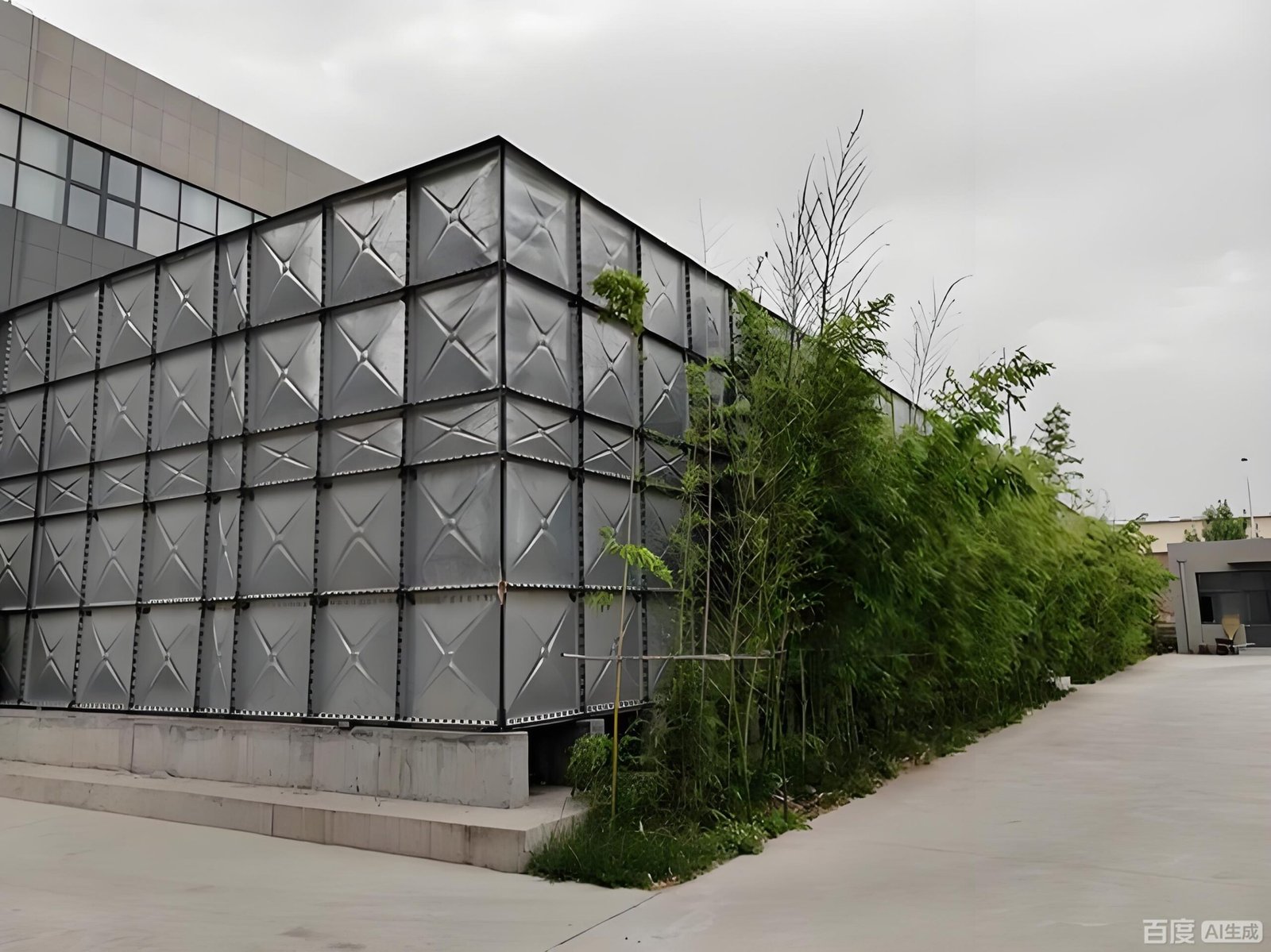
Widely used for municipal storage for their modular construction, strong structural performance and efficient site assembly. Depending on water type, the steel may use galvanizing, coating or lining.

Hot-Dip Galvanized Tanks
Steel strength with zinc corrosion protection. For potable applications, the internal water-contact condition should be reviewed carefully according to project requirements.
GRP / FRP Sectional & Concrete
GRP/FRP tanks are lightweight, modular and corrosion-resistant — common in building supply, community storage and fire reserve. Concrete suits some large permanent projects but needs more site construction and waterproofing management.
Material Selection Matrix
| Project priority | Strong candidates | Why |
|---|---|---|
| Potable water hygiene | Stainless steel, approved coated steel, suitable GRP/FRP | Cleanability and water-contact suitability matter |
| Fast installation | Bolted steel, stainless bolted, GRP/FRP sectional | Factory-made panels shorten site work |
| Remote delivery | Bolted steel, GRP/FRP sectional | Compact shipping and site assembly |
| High structural demand | Bolted steel, coated steel, concrete | Depends on capacity, site and standards |
| Coastal exposure | 316 stainless steel, suitable coating system | Salt exposure increases corrosion risk |
| Budget control | Galvanized steel, coated steel, GRP/FRP | Must still match water requirements |
| Long maintenance interval | Stainless steel, high-quality coated steel | Higher upfront cost may reduce lifecycle risk |
This matrix does not replace engineering review, but it helps owners compare options before requesting supplier proposals.
Water Quality and Hygiene
For potable water storage, the tank must be designed to reduce contamination risk and support inspection and cleaning. Important points include suitable water-contact materials, smooth internal surfaces where possible, properly sealed roof and access openings, vent design that prevents debris entry, drainage arrangement for cleaning, manhole access for inspection, and avoidance of dead zones where water stagnates — supported by a maintenance plan for periodic cleaning.
Water age is another important factor. Oversized tanks with poor turnover may increase water quality risk. Engineers should balance reserve requirements with circulation and operational control.
Structural Design Factors
A municipal tank must remain reliable under full operating load and local environmental conditions. Structural review should include filled tank weight, hydrostatic pressure, wind load, seismic conditions if applicable, foundation settlement risk, roof load and access load, external corrosion exposure, and thermal expansion or temperature variation. For bolted tanks, panel thickness, bolt arrangement, gasket performance and reinforcement design all affect long-term stability.

Standards, Site & Accessories
Documentation buyers should ask for
Municipal projects often require more documentation than commercial building tanks. Useful items include the general arrangement drawing, foundation load information, panel material specification, coating or material data sheet, nozzle schedule, packing list, installation manual, quality inspection record, welding/coating/galvanizing documentation where applicable, and operation and maintenance guidance. If a supplier can only quote a price but cannot support drawings and documents, the project may face approval delays later.
Site and foundation planning
Before production, review installation access, crane or lifting requirements, foundation conditions and future maintenance space. Foundation planning should consider soil bearing capacity, levelness, drainage around the tank, anchor requirements if applicable, access for installation crews, space for piping and valves, and safe access for inspection. A well-prepared foundation reduces installation risk and helps prevent leakage or structural stress caused by uneven support.
Accessories and connections
Municipal tanks usually need more than basic inlet/outlet connections: overflow, drain, vent, manhole, ladder and platform, level indicator, internal or external reinforcement, optional insulation, and sampling or inspection access. Connection positions should be confirmed before production because they affect panel layout, site piping and maintenance access.
Inspection, Maintenance & Failure Modes
Municipal water storage tanks should be inspected regularly; the schedule depends on local regulations, water quality, tank material, operating conditions and project policy. Typical items include external visual inspection, internal cleanliness review, checking bolts and connections, gasket and sealing inspection, roof and vent inspection, drainage and overflow review, coating or surface condition check, and cleaning and disinfection when required. The goal is to catch small issues before they become leakage, contamination or structural problems.
Failure modes to prevent
The most expensive municipal tank problems usually come from predictable causes:
Poor water turnover — the tank is oversized or hydraulically poorly arranged, creating stagnant zones.
Wrong material selection — material does not match water chemistry or site exposure.
Inadequate foundation — settlement or uneven support creates stress and leakage risk.
Unprotected openings — vents, manholes or roof details allow contamination risk.
Difficult cleaning access — maintenance is skipped because access is unsafe or inconvenient.
Unclear responsibility — owner, contractor and supplier do not agree who handles installation, inspection and commissioning.
How to Choose the Right Municipal Tank
A practical selection process begins with the project requirement, not the product catalog. Ask first: is the stored water potable, raw, treated, fire reserve or mixed-use? What is the required usable capacity and reserve volume? What is the expected service life? Is the site indoor, outdoor, coastal, seismic or remote? What documentation is required for approval? What maintenance capability will the operator have? Is future expansion likely? Once these answers are clear, material selection becomes far easier.
Modular tanks — especially bolted steel, stainless steel bolted and GRP sectional tanks — are useful for municipal projects because they simplify shipping and installation. Panels can be transported to remote sites and assembled on prepared foundations, which is especially valuable for overseas projects, island locations, mountainous areas and communities where large tank delivery is not practical. Modular construction also helps when schedules are tight: while the foundation is prepared on site, panels are produced in the factory.
Standards and Compliance for Municipal Potable Storage
Municipal potable projects usually require documented compliance, not just a tank price. ZENTVO specifies potable water tanks to NSF/ANSI 61 and WRAS for water contact, and to AWWA D103 (bolted steel) or API 650 (welded steel) for structural design, with EN standards applied where required. Tanks are manufactured under ISO-certified management systems, with certified materials, factory inspection, and dimensional and sealing tests, and full submittal documentation (GA drawings, material data, nozzle schedule, QC records) to support approval.
RFQ Checklist for Municipal Potable Water Storage
Use the following checklist when sending an inquiry — the more complete it is, the more useful the proposal you receive:
Send With Your Inquiry
- Project location & environment
- Required usable capacity
- Population / demand basis, if available
- Potable / raw / mixed-use storage
- Fire reserve requirement, if any
- Water analysis or treatment method
- Preferred material or need for recommendation
- Site layout & available footprint
- Indoor / outdoor / rooftop / ground
- Wind, seismic or structural requirements
- Nozzle schedule & pipe connection sizes
- Required drawings, standards & documents
- Installation responsibility & delivery date
Planning a Municipal Potable Water Storage Project?
Send ZENTVO your capacity, water type, site location and approval requirements. Our team can recommend a suitable material, prepare a preliminary layout, and help you compare stainless steel, bolted steel, galvanized steel and GRP/FRP options.
Municipal Water Storage Support
ZENTVO supports municipal water storage projects with product selection, technical review and customized tank proposals — recommending stainless steel bolted tanks, bolted steel tanks, hot-dip galvanized tanks, coated steel tanks or GRP/FRP tanks depending on the application. Every project starts with a free 24-hour engineering package (CAD/GA drawings, structural load calculation, and material recommendation), followed by certified manufacturing at our manufacturing facility, export packaging, delivery in roughly 15–35 working days (EXW / FOB / CIF / DAP), installation guidance, spare parts, and a 24/7 technical hotline.
Compliance covers NSF/ANSI 61 and WRAS (potable), AWWA D103 and API 650 (structural), EN standards, and ISO-certified management systems. Contact: info@zentvo.com · +86 153-1889-6990.
Frequently Asked Questions
What is a municipal potable water storage tank?
It is a water storage tank designed for public or community drinking water supply. It supports daily balancing, peak demand, emergency reserve and distribution stability while protecting potable water quality.
What is the best material for municipal water storage tanks?
The best material depends on water quality, capacity, environment, budget and local requirements. Stainless steel, bolted steel, galvanized steel, coated steel, GRP/FRP and concrete may all be suitable in different conditions.
How do you size a municipal water tank?
Sizing should consider average demand, peak demand, emergency reserve, fire reserve, pumping schedule, future growth and water turnover. A professional engineering review is recommended.
Can bolted tanks be used for municipal potable water?
Yes, bolted tanks can be used for municipal potable water when the material, internal surface, sealing system and documentation are suitable for the project.
Why is maintenance important for potable water tanks?
Maintenance helps protect water quality, prevent leakage, identify corrosion or sealing issues and extend the service life of the tank system.