Hot-Dip Galvanized vs Coated Steel vs Stainless Steel Water Tanks
Three steel tank systems, three different risk profiles. The right choice depends on water chemistry, site exposure, approval requirements and lifecycle cost — not price alone.
Hot-dip galvanized water tanks are usually chosen for cost-effective steel strength, coated steel tanks for project-specific corrosion protection, and stainless steel tanks for potable water, hygiene-sensitive or more corrosive environments. All three can be effective — but they are not interchangeable.
Key Takeaways
- Do not choose tank material by price alone.
- Hot-dip galvanized steel is practical when zinc protection is compatible with the stored water and site.
- Coated steel is useful when the project needs a defined internal or external protection system.
- Stainless steel is often preferred for potable water, hygiene-sensitive storage and corrosive environments.
- 304 and 316 stainless should be selected by chloride exposure and operating conditions.
- For serious projects, send water analysis and site conditions before asking for a final recommendation.
The Material Decision Is Really a Risk Decision
Steel water tanks fail early when corrosion risk, water chemistry or maintenance access is underestimated. A low-price tank can become expensive if the coating fails, the wrong stainless grade is used, or the water is not compatible with galvanized steel. The material decision should control four risks:
Water Safety
Will the tank material be suitable for the stored water?
Corrosion
Will internal or external corrosion shorten service life?
Maintenance
Can the owner inspect, clean and repair the tank?
Approval
Can the supplier provide documents the project needs?
This is why material selection should happen before final price comparison.
Side-by-Side Material Profiles

Hot-Dip Galvanized
Steel protected by a zinc coating — a protective barrier that reduces corrosion risk in many environments.
- Strong steel structure
- Good cost performance
- Zinc coating protection
- Modular bolted construction available
- Efficient packing & shipping for export
- Review needed for aggressive water or strict potable rules
- pH, chloride, temperature affect suitability
Coated Steel
Steel structure protected by an internal and/or external coating system, selected by water type and exposure.
- Strong steel structure
- Flexible coating options
- Designable for different water types
- Good where galvanizing alone isn’t enough
- Modular bolted construction possible
- Performance depends on surface prep & application quality
- A coating good for one water may not suit another

Stainless Steel
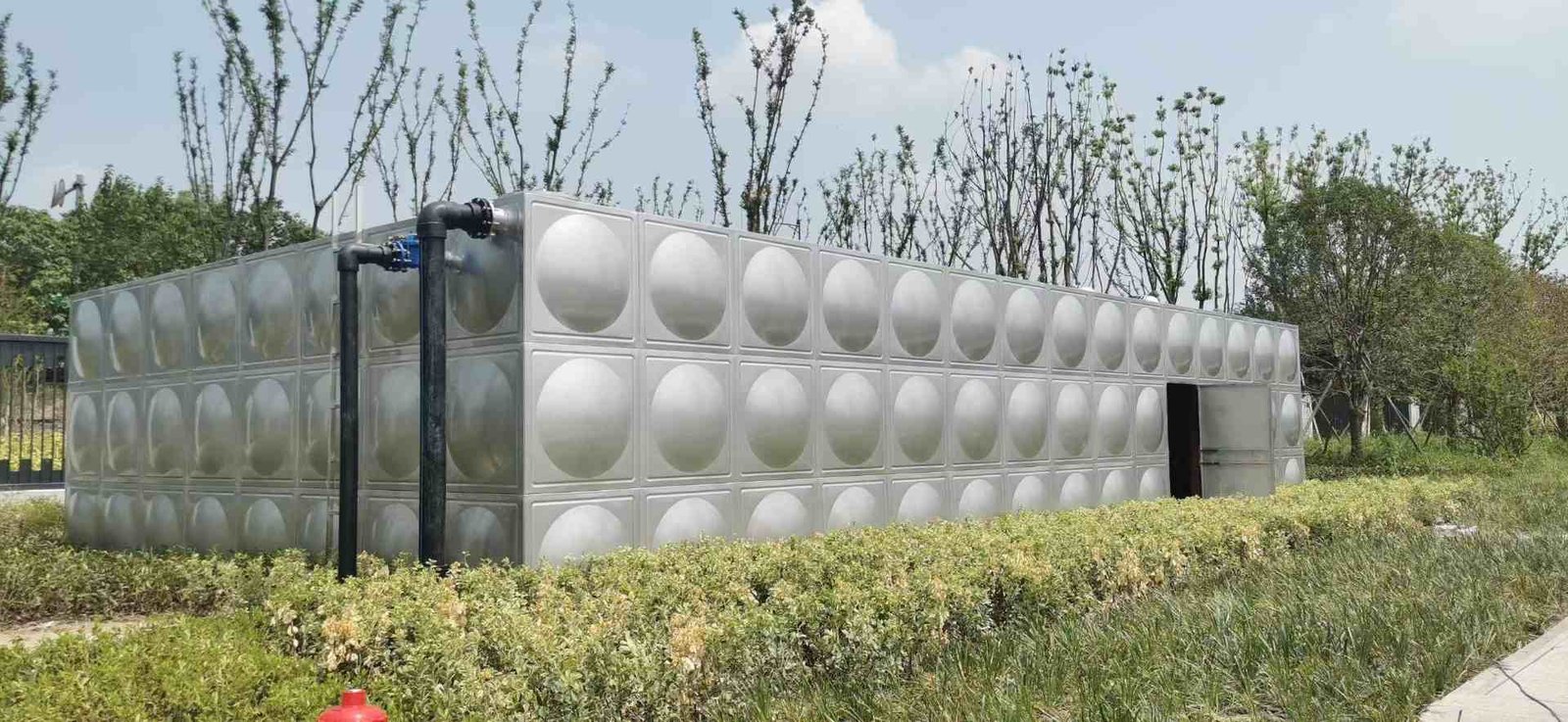
Stainless panels or plates, commonly 304 or 316 — valued for clean surface, corrosion resistance and hygiene.
- Clean internal surface
- Strong corrosion resistance
- Suitable for many potable projects
- 304 & 316 grade options
- Bolted or welded systems
- Higher cost than galvanized/coated
- Still requires correct 304/316 grade selection
Explore each system in detail: hot-dip galvanized water tank, coated steel water tank, and stainless steel bolted tank.
Quick Comparison
| Tank material | Main advantage | Common applications | Key concern |
|---|---|---|---|
| Hot-dip galvanized | Cost-effective steel strength with zinc protection | Fire reserve, industrial, general storage, project water | Water chemistry & zinc compatibility |
| Coated steel | Flexible corrosion protection with project-specific coating | Municipal, industrial, raw water, fire water, special environments | Coating selection & surface preparation |
| Stainless steel | Clean surface & strong corrosion resistance when correctly specified | Potable water, hygiene-sensitive storage, coastal/demanding environments | Higher cost & correct grade selection |
There is no single best material. The best tank is the one that matches the project conditions.
When Not to Use Galvanized Steel Without Review
Hot-dip galvanized steel is a strong practical option — but it should not be selected automatically. Review carefully (and consider coated steel, stainless steel or a liner system) when:
Review Before Selecting Galvanized
- The water is potable and local rules require specific approved contact materials.
- Chloride content is high.
- Water pH is outside normal compatible ranges.
- The site is coastal or highly corrosive.
- The tank will store chemically treated industrial water.
- The owner expects very long maintenance intervals without inspection.
Coating Selection Questions
For coated steel tanks, the coating system matters as much as the steel. If these questions cannot be answered, the coating recommendation is incomplete:
- What coating type is proposed for internal water contact?
- What coating type is proposed for external exposure?
- What surface preparation is required before coating?
- What dry film thickness is specified?
- How are panel edges, bolt holes and nozzles protected?
- What inspection method is used before shipment?
- What repair procedure is required after site assembly?
- Is the coating suitable for the stored water temperature and chemistry?
304 vs 316 in Tank Selection
| Condition | 304 stainless steel | 316 stainless steel |
|---|---|---|
| Normal indoor potable water | Often suitable | Optional |
| Coastal environment | Review carefully | Usually preferred |
| Higher chloride water | Usually not preferred | Better candidate |
| Hygiene-sensitive commercial building | Often suitable | Optional for stricter conditions |
| Industrial water | Depends on chemistry | Depends on chemistry |
Stainless steel is not a single material — the grade matters. If a project asks for “stainless steel tank” without confirming 304 or 316, the quotation may not be technically comparable.
Water Type & Installation Environment
Water chemistry can change the material recommendation. Before selecting a tank, review potable or non-potable water, pH level, chloride content, temperature, disinfection method, sediment or suspended solids, any industrial chemicals, and the required water-contact documentation.
| Water type | Better candidates | Main reason |
|---|---|---|
| Potable water | Stainless steel, approved coated/liner, selected GRP/FRP | Hygiene & water-contact requirements |
| Fire reserve water | Galvanized steel, coated steel, bolted steel | Large capacity & cost control |
| Industrial process water | Coated steel, stainless steel | Chemistry-specific protection |
| Raw water | Coated steel, galvanized if compatible | Sediment & corrosion review needed |
| Seawater / high chloride | 316 stainless or specialized coating | Chloride corrosion risk |
| Agricultural water | Galvanized, coated steel, GRP/FRP | Practical cost & delivery |

The site environment is as important as the stored water. Coastal sites raise corrosion risk from salt — 316 stainless or a suitable coated system may perform better long-term. Industrial sites may carry chemicals, dust or gases affecting external corrosion. Indoor mechanical rooms face less external corrosion but more space, access and hygiene constraints. Hot or cold climates influence material, insulation and accessory design through temperature and thermal movement.
Cost & Lifecycle
Cost should be evaluated as total project cost, not only purchase price. Hot-dip galvanized usually offers strong cost performance when water and environment are compatible. Coated steel cost depends on coating type, surface prep, inspection and size — often more than basic galvanized, but better protection for some applications. Stainless steel usually has the highest initial cost (especially 316), but may reduce lifecycle risk in potable, hygiene-sensitive or corrosive settings.
The lowest purchase price is not always the lowest lifetime cost. A true lifecycle comparison includes initial price, freight and packing, site assembly labor, inspection and testing, cleaning and maintenance frequency, coating repair or replacement, downtime during repair, risk of water quality issues, and expected service life. Early corrosion, recoating, leakage or water quality problems can be far more expensive than selecting the right material from the start.
Which Tank Should You Choose?
Use this practical decision path:
Hot-dip galvanized — when the project needs cost-effective structural storage and the water chemistry is compatible.
Coated steel — when the project needs steel strength plus a specific internal or external protection system.
Stainless steel — when potable water quality, hygiene, cleanability or stronger corrosion resistance is the priority.
If the project is large, remote or export-based, bolted construction can make any of these material systems easier to deliver and assemble.
Example Selection Scenarios

Municipal Potable Water
Review stainless steel, coated steel or properly specified bolted steel depending on local standards, water quality and budget.

Fire Reserve Tank
Hot-dip galvanized or coated steel may be practical, depending on capacity, site exposure and maintenance plan.
Coastal Commercial Building
Stainless 316 or a suitable coated system should be reviewed — salt exposure increases corrosion risk.

Industrial Process Water
Water chemistry should drive the decision. Coated steel or stainless may be required if the water is aggressive.
Remote Infrastructure
A bolted steel system simplifies shipping and site assembly; material still based on water type and exposure.
Maintenance Requirements
All water tanks need inspection and maintenance. Galvanized tanks should be checked for coating condition, corrosion signs, bolts, gaskets and internal cleanliness. Coated steel tanks require coating inspection — especially at edges, joints, penetrations and high-wear areas. Stainless steel tanks should be inspected for surface condition, contamination, chloride-related corrosion risk, gasket condition and cleaning needs. Maintenance planning should be included in the material selection stage, especially for municipal and industrial projects.
Procurement Mistakes to Avoid
Standards That Should Drive the Decision
Material selection ties directly to the standards a project must meet. For potable water, the water-contact material — whichever steel system is chosen — should comply with NSF/ANSI 61 and WRAS; bare galvanized steel is reviewed against these rather than assumed compliant. Structural design follows AWWA D103 for bolted steel or API 650 for welded steel, with EN standards applied by region. ZENTVO manufactures all three material systems under ISO-certified management systems, with certified materials, factory inspection, and dimensional and sealing tests.
Send This for a Material Recommendation
To receive a reliable tank recommendation instead of a generic product, prepare:
RFQ Checklist
- Capacity
- Water type
- Water analysis, if available
- Potable water requirement: yes / no
- Installation country
- Indoor or outdoor
- Coastal or industrial exposure
- Desired service life
- Preferred tank material, if any
- Required standards or documents
- Nozzle schedule
- Target delivery date
Galvanized, Coated or Stainless — Need Help Choosing?
Send ZENTVO your water type, capacity and installation environment. We’ll recommend the most suitable tank material and explain the trade-offs before quotation — with a free 24-hour engineering review.
ZENTVO Steel Water Tank Solutions
ZENTVO supplies hot-dip galvanized water tanks, coated steel water tanks and stainless steel bolted water tanks (304/304L and 316/316L) for municipal, industrial, fire protection and commercial projects. Our engineering team can review your project conditions and recommend a practical material system, tank structure and delivery plan — starting with a free 24-hour engineering package (CAD/GA drawings, structural load calculation, material recommendation), then certified manufacturing at our manufacturing facility and delivery in roughly 15–35 working days (EXW / FOB / CIF / DAP) with installation guidance, spare parts, and a 24/7 technical hotline.
Whether your priority is cost control, potable water compatibility, corrosion resistance or fast installation, ZENTVO can help select the right tank before production begins. Contact: info@zentvo.com · +86 153-1889-6990.
FAQ
Is stainless steel better than galvanized steel for water tanks?
Stainless steel offers stronger corrosion resistance and better hygiene performance in many applications, but it also costs more. Galvanized steel can be a practical choice when the water and environment are compatible.
What is the difference between galvanized and coated steel water tanks?
Galvanized steel is protected by zinc coating. Coated steel uses a selected coating system to protect the steel. Coated steel can be customized for specific water or environmental conditions.
Can galvanized steel tanks store drinking water?
This depends on local requirements, water chemistry and internal contact materials. Potable water applications should be reviewed carefully before selecting galvanized steel.
Which tank material is best for coastal areas?
Coastal areas increase corrosion risk. Stainless steel 316 or a suitable coated steel system is often reviewed for better long-term performance.
Which material is most cost-effective?
Hot-dip galvanized steel often has strong initial cost performance. However, lifecycle cost depends on water chemistry, environment, maintenance and expected service life.