For water within pH 3–11, ≤ 80 °C, ≤ 1,000 ppm Cl⁻, with a 25-year-plus design horizon and limited site repair access, glass-fused-to-steel (GFS) is usually the right answer — it costs 15–30 % more upfront but typically wins on 20-year NPV because it does not require a mid-life recoat. For water outside that envelope, specific coating approvals, or where site repair access is straightforward, an engineered epoxy system is usually the right answer.
Long-life (25+ yr), municipal/utility/fire reserve, limited maintenance access, water within pH 3–11 / ≤ 80 °C / ≤ 1,000 ppm Cl⁻
Custom chemistry (brackish, demin, high-temp), lower upfront budget, specification flexibility, accessible site for periodic recoat
The mistake to avoid is comparing them as if they were the same product family. They differ in coating bond mechanism, thickness, pH/temperature envelope, repair logic, standards regime, and lifecycle cost. This guide includes the standards, the numbers, and a worked 20-year cost comparison for procurement, EPC and consulting engineers.
Quick Quantitative Comparison
GFS Water Tank
Vitreous enamel fused metallurgically at ~900 °C · ISO 28765 · AWWA D103-09 §10
- 250–400 μm per face — factory-fired, no adhesive interface
- pH 3–11 continuous; 80 °C max (95 °C excursions)
- 30+ year design life — no recoat event
- NSF 61 / WRAS available for all wetted parts
- Container shipment advantage for remote/overseas sites
- Bounded envelope: pH <3 or >11 → switch systems
- Field repair limited to glass-flake epoxy patch
- Brittle at sharp impact during installation
Coated Steel Tank
Epoxy system applied to SSPC-SP10 / ISO 8501-1 Sa 2½ blasted substrate · AWWA D102 / D103 §11
- 300–500 μm DFT — system selectable per chemistry
- Novolac: pH 2–12, 95 °C; FBE: pH 4–12, 80 °C
- Lower CAPEX — 1.00× baseline
- Wider chemistry envelope with correct system selection
- Field repair with same or compatible epoxy system
- First recoat at year 12–15 (2–4 weeks tank out of service)
- Surface-prep dependent: SP6 instead of SP10 cuts life 30–50 %
- Buyer must specify which system — "epoxy" alone is not a spec
| Parameter | Glass-Fused-to-Steel | Epoxy-Coated Steel |
|---|---|---|
| Coating bond | Fused metallurgically at ~900 °C (no adhesive interface) | Chemical + mechanical adhesion to blasted steel |
| Coating thickness | 250–400 μm each face, fused | 300–500 μm DFT (system-dependent) |
| Governing coating standard | ISO 28765, AWWA D103-09 §10 | AWWA D102, AWWA D103-09 §11, NSF/ANSI 61 |
| Surface prep standard | Shot blast + degrease + frit + fire | SSPC-SP10 / NACE No. 2 / ISO 8501-1 Sa 2½ |
| pH range (continuous) | 3–11 | 4–10 (standard); 2–12 (epoxy-novolac) |
| Max continuous temp. | 80 °C (95 °C short excursions) | 60 °C standard; 95 °C (novolac) |
| Chloride tolerance | ≤ 1,000 ppm typical | ≤ 500 ppm standard; ≤ 5,000 ppm (novolac/FBE) |
| Recoat interval | None (30+ years) | 10–15 years typical first recoat |
| Service life | 30+ years | 15–25 years (maintenance dependent) |
| Holiday test | 1.5 kV wet-sponge post-install | ASTM D5162 — 5 V per μm DFT; spark for >500 μm |
| Potable certification | NSF 61 / WRAS available | NSF 61 / WRAS available (system-specific) |
| Relative CAPEX | 1.15–1.30× | 1.00× (baseline) |
| 20-year NPV (relative) | 0.95–1.05× (no recoat) | 1.00× (one recoat at year 12–15) |
The Real Decision: Six Quantitative Gates
If four or more gates favour GFS, specify GFS. If three or more favour epoxy, specify the matching epoxy system. If gates conflict, the decision drops to lifecycle cost (next section).
20-Year Lifecycle Cost — Worked Example

Project: 1,500 m³ bolted modular potable water tank, NSF 61, AWWA D103 jurisdiction, moderate cleanability access, water at pH 7.5, 25 °C, Cl⁻ 200 ppm.
Water Chemistry Decision Matrix
Match your water analysis to this table before selecting a system. See the fire water tank design guide for fire-reserve-specific chemistry guidance.
| Stored water | pH | Cl⁻ | Max Temp | Recommended coating |
|---|---|---|---|---|
| Soft potable / municipal | 6.5–8 | <250 ppm | <30 °C | GFS (default) or NSF 61 epoxy |
| Chlorinated potable | 6.5–8 | <500 ppm | <30 °C | GFS with NSF 61/WRAS gaskets |
| Brackish / raw water | 6–8 | 500–5,000 ppm | <40 °C | Epoxy-novolac or FBE |
| Seawater | 7.5–8.5 | ~19,000 ppm | <40 °C | 316L stainless or rubber-lined |
| Demineralised / DI water | 5.5–7 | <1 ppm | varies | Epoxy-phenolic or 316L stainless |
| Industrial cooling water | 7–9 | variable | 30–60 °C | Epoxy-novolac or GFS if Cl⁻ ≤1,000 ppm |
| Fire reserve (stagnant) | 6.5–8 | <250 ppm | <40 °C | GFS (stagnation tolerance), NSF 61 epoxy OK |
| Wastewater buffer / reclaimed | 6–9 | variable | <35 °C | Epoxy-novolac or rubber-lined |
| Mining process water | 2–11 | variable | up to 60 °C | Rubber lining, epoxy-novolac, or 316/2205 SS |
| Hot industrial utility | 7–8 | <500 ppm | 60–95 °C | Epoxy-novolac (95 °C) or SS |
| Hydrocarbon-adjacent water | varies | varies | varies | Epoxy-phenolic or FBE — never standard amine epoxy |
Glass-Fused-to-Steel — Engineering Reality
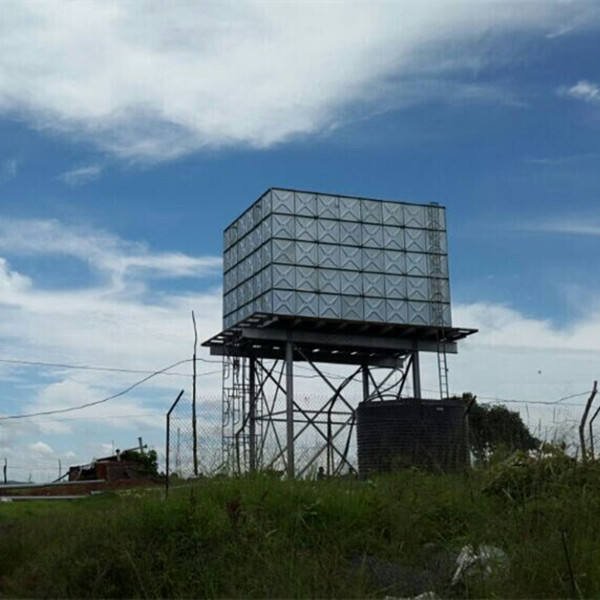
GFS is produced by spray-applying a glass frit onto a shot-blasted, degreased carbon-steel panel and firing the assembly in a tunnel kiln at approximately 900 °C. The frit melts and fuses metallurgically with the steel surface — there is no adhesive interface, so delamination cannot occur the way a paint film can fail. The coating is hard (Mohs 5–6), chemically inert across pH 3–11, and approximately 250–400 μm thick per face.
Standards: ISO 28765 (vitreous and porcelain enamels for bolted steel tanks), AWWA D103-09 Section 10, with NSF/ANSI 61 or WRAS BS 6920 for potable.
Where it wins: factory-controlled coating consistency (no site weather dependency), 30+ year design life with no recoat, low maintenance burden, container shipping advantages for remote/overseas projects.
Where it loses: limited site repair toolkit (glass-flake epoxy patches), brittle at sharp impact, bounded by pH 3–11 and ≤ 80 °C envelope. → ZENTVO Glass-Fused-to-Steel product page
Epoxy-Coated Steel — Engineering Reality
"Epoxy-coated steel" is a family, not a single product. The buyer must specify which system:
| Epoxy system | DFT typical | pH range | Max T | Standout property | Typical application |
|---|---|---|---|---|---|
| Standard amine-cured epoxy | 300–400 μm | 4–10 | 60 °C | Lowest cost | General potable / utility |
| Epoxy-novolac | 400–500 μm | 2–12 | 95 °C | Chemical resistance | Brackish, hot, industrial |
| Epoxy-phenolic | 300–450 μm | 1–13 | 90 °C | Solvent / hydrocarbon resistance | Demin water, fuel-contact-adjacent |
| Fusion-bonded epoxy (FBE) | 300–450 μm | 4–12 | 80 °C | Factory-applied, fast cure | Modular panel coating, pipeline-style |
| Glass-flake epoxy | 500–800 μm | 3–11 | 70 °C | Abrasion + chloride resistance | Wastewater, brackish, marine splash |

Standards: AWWA D102 (Coating Steel Water-Storage Tanks), AWWA D103-09 Section 11, SSPC-SP10 / NACE No. 2 / ISO 8501-1 Sa 2½ for surface prep, ASTM D5162 for holiday detection.
Where it wins: coating system tunable to chemistry, wider pH and temperature envelope with right system, easier in-service patch repair, lower CAPEX.
Where it loses: surface-prep dependent (SP6 instead of SP10 cuts life 30–50 %), recoat event at year 12–15 carries downtime cost, more decisions for the buyer. → ZENTVO Coated Steel Water Tank product page
When Neither Is the Right Answer
| Condition | Specify instead |
|---|---|
| Cl⁻ > 5,000 ppm continuous | 316L or 2205 duplex stainless steel |
| Continuous service > 95 °C | Stainless steel (304/316) |
| Aggressive sulphuric / phosphoric acid | Rubber-lined steel or PE |
| Frequent abrasive mechanical cleaning (every 6–12 months) | Stainless steel or rubber-lined |
| Cryogenic or sub-zero process | Insulated stainless with engineered system |
| Live fuel / oil immersion | Epoxy-phenolic or carbon steel with cathodic protection |
Also compare with hot-dip galvanized steel for fire reserve and soft-water utility where pH 6–8, and with bolted steel tank selection for the platform overview.
Failure Modes — Specific to Each Coating
| Coating | Failure mode | Root cause | Prevention |
|---|---|---|---|
| GFS | Edge chipping | Forklift / sling damage during transit | Edge firing, soft slings, packing drawing compliance |
| GFS | Holiday at bolt-hole | Coating thinning at radius | 1.5 kV wet-sponge holiday test post-install; glass-flake epoxy touch-up |
| GFS | Coating attack outside pH 3–11 | Wrong specification or chemistry drift | Confirm water chemistry vs envelope at PO stage |
| Epoxy | Blistering / delamination | Poor surface prep (SP6 instead of SP10) or moisture | Specify SP10 / Sa 2½; dew-point monitoring during application |
| Epoxy | Premature chalking external | UV exposure without polyurethane topcoat | Specify external PU finish for outdoor tanks |
| Epoxy | Recoat adhesion failure | Original coating not properly cleaned before recoat | Recoat per AWWA D102 procedure; surface tooth re-established |
| Epoxy | Holiday at weld seams | Incomplete surface prep on welds | Stripe-coat welds; holiday test per ASTM D5162 |
| Either | Bolt-head corrosion in wetted zone | Untreated bolt head in contact with water | PVC-encapsulated bolt caps — required for both systems |
Procurement Scoring Matrix — Worked Example
Fill in your own scores (1–5) per project. For Cl⁻ > 1,000 ppm or service > 80 °C, the "Liquid compatibility" row inverts and the totals usually flip.
Common Procurement Mistakes
Comparing coatings by name, not by system
"Epoxy-coated" without DFT, surface prep, holiday test and recoat procedure is not a specification. Every quotation needs all four.
Assuming GFS fits every water chemistry
GFS is bounded by pH 3–11, ≤ 80 °C, ≤ 1,000 ppm Cl⁻. Outside that envelope, epoxy-novolac or stainless is the answer.
Ignoring surface prep grade on epoxy
SSPC-SP6 (commercial blast) is not equivalent to SP10 (near-white). Substituting SP6 cuts epoxy coating life by 30–50 %.
Comparing CAPEX without NPV
A 15–30 % CAPEX premium for GFS is recovered in years 12–18 through avoided recoat. Without NPV, the comparison is incomplete.
Approving "NSF 61 coating" not "NSF 61 system"
NSF 61 must apply to all wetted components (panels, gaskets, sealants, bolt heads), not only the panel coating.
Missing the recoat window in lifecycle planning
Epoxy recoat at year 12–15 requires drain, clean, prep, recoat — typically 2–4 weeks of tank-out-of-service. Plan a parallel tank.
Specification Checklist — Apples-to-Apples Quotations
Reject any quotation that does not include all items for the chosen system:
- ISO 28765 coating compliance statement
- Coating thickness per face (μm) and firing temperature profile
- AWWA D103-09 §10 compliance statement
- Holiday test method + acceptance (1.5 kV wet-sponge)
- NSF 61 or WRAS certificate — for all wetted parts, not panels only
- Edge / bolt-hole treatment detail
- Field touch-up kit specification (glass-flake epoxy)
- Specific system (manufacturer + product code, e.g. "Hempel Hempadur 35760")
- DFT per coat and total (μm); number of coats
- Surface prep standard (SSPC-SP10 / NACE No. 2 / ISO 8501-1 Sa 2½) and profile (Rz)
- Stripe-coat at welds; holiday test (ASTM D5162)
- NSF 61 / WRAS certificate for the specific product (not coating family)
- Recoat procedure and recoat interval
- Field repair material (same product family)
Frequently Asked Questions
Is glass-fused-to-steel always better than epoxy-coated steel?
What does "epoxy-coated" actually mean in a specification?
What is the service life of a GFS tank vs an epoxy-coated tank?
Which is cheaper over 20 years?
Can either coating be used for potable water?
Why does surface preparation matter so much for epoxy?
Can a GFS tank be repaired on site?
What is the best procurement question to ask a supplier?
Ready to compare GFS vs Epoxy for your project?
Send water analysis, capacity, governing standard and site country. ZENTVO returns two quotations — GFS and best-fit epoxy — same scope, apples-to-apples, within 24 hours.