
What Size GRP Water Tank Do I Need? A Practical Sizing Guide for African Building Projects
Estimate demand, set storage days, add safety, separate fire reserve if required, and turn litres into a sectional GRP layout that fits your site—before MEP and procurement lock in.
Start with the formula

sizing steps
Why tank size is decided this early
Getting the water tank size right is one of the earliest decisions that shapes a building project’s MEP scope, structural loading, and long-term service reliability. Pick a tank that is too small and you face water shortages during peak demand, pump short-cycling, and complaints from building occupants. Pick one that is too large and you waste budget, occupy space that could serve other equipment, and risk water quality problems from excessive retention time.
For EPC contractors and project engineers working across Africa, the sizing sequence follows a clear path: estimate daily demand, decide how many days of reserve storage the project needs, apply a reasonable safety factor, account for fire reserve where required, and then translate the target volume into a GRP water tank layout that actually fits the site. This guide walks through each step with the practical detail that generic online calculators leave out.
The core formula for GRP water tank capacity
The starting point is a formula most engineers already know:
Required tank capacity = Daily water demand × Storage duration × Safety factor
This is useful for early-stage building estimates, especially when the tank serves domestic or general building water supply. It gives contractors a quick comparison figure before the final MEP design is locked.
What the formula does not include automatically: fire-fighting reserve, projected occupancy growth, maintenance downtime allowance, municipal refill constraints, or physical footprint limits. Treating the formula output as a final answer, without checking these factors, is one of the most common mistakes in preliminary sizing. Fire storage, in particular, usually follows its own code-based flow-and-duration calculation rather than a simple day-based reserve rule.
Estimate daily water demand by building type
The first job is to estimate how much water the building consumes in a typical day. At the early planning stage, this is done with benchmark values rather than final construction drawings.
For residential projects, demand is typically estimated per person or per apartment unit. Hotels work best when calculated per guest, then adjusted for occupancy rate and additional services such as restaurants, pools, or laundry. Hospitals base demand on bed count plus support functions. Schools and office buildings use student count, staff count, or total occupant figures depending on the design approach.
Benchmarks are a starting line, not the finish. Do not treat published values from other regions as automatic truth for every African site. Actual demand varies with municipal supply reliability, fixture density, plumbing practice, occupancy behaviour, and whether the facility includes canteens, irrigation, or process water loads. Use benchmarks to build a first estimate, then refine once consultant schedules and project-specific data are available.
Decide storage duration based on supply reliability
Storage duration has a disproportionate impact on tank size. The same building designed for one day of storage may need only half the tank volume compared to the same building designed for two days.
As a practical rule: one day of storage is often acceptable where municipal supply is stable and refill is reliable. When the incoming water source is intermittent, irregular, or dependent on tanker delivery, storage duration typically increases. Remote sites, infrastructure camps, and developments in areas with periodic utility interruption need a larger buffer, sometimes two days or more.
The key question is not only “How much water do occupants use?” but also “How dependable is the water source that refills the tank?” For many African building projects, this decision carries more weight than most generic sizing articles acknowledge. A tank sized purely on ideal supply assumptions may look correct on paper but fail in service if interruptions are frequent. At the same time, increasing storage days beyond what turnover can support introduces a different risk: water sits in the tank longer than it should, which can affect quality, particularly in warm climates.
Apply a safety factor without oversizing
A moderate safety factor helps absorb usage variation, occupancy fluctuation, and minor estimating errors. In early design, many project teams apply a buffer of around 10–20% rather than attempting to model every conceivable maximum event.
The mistake is treating the safety factor as a license to oversize. A tank that holds far more water than the building actually turns over increases stagnation risk, raises structural loading, adds to installation and procurement cost, and may create layout conflicts that were entirely avoidable. The right question is not “How large can the tank be?” but “What volume gives reliable operation without wasting space, budget, and water quality margin?”
Separate domestic storage from fire reserve
This is the step that many preliminary sizing discussions handle poorly. Domestic water and fire-fighting water are not the same requirement, and they should not be combined by default.
Fire reserve is typically a code-driven calculation tied to required fire flow rate, duration, and the connected fire-protection system design. NFPA guidance, for example, sizes private fire-protection storage based on flow, duration, and water level control, not as an extension of daily domestic consumption.
For EPC contractors, the practical implication is straightforward: confirm early whether the project requires a dedicated fire water tank, a compartmentalized arrangement within a single tank, or completely separate domestic and fire tanks. Do not assume that one combined storage volume will automatically satisfy both the MEP consultant and the fire engineer. If you need a dedicated fire tank, see FRP fire-fighting water tank options and coordinate with the fire design.
Convert capacity into sectional tank dimensions
Once the required volume is established, the next question is not “Which catalogue tank is closest?” but “What tank dimensions actually fit the available space?”
Volume = Length × Width × Height (internal dimensions, per manufacturer method)
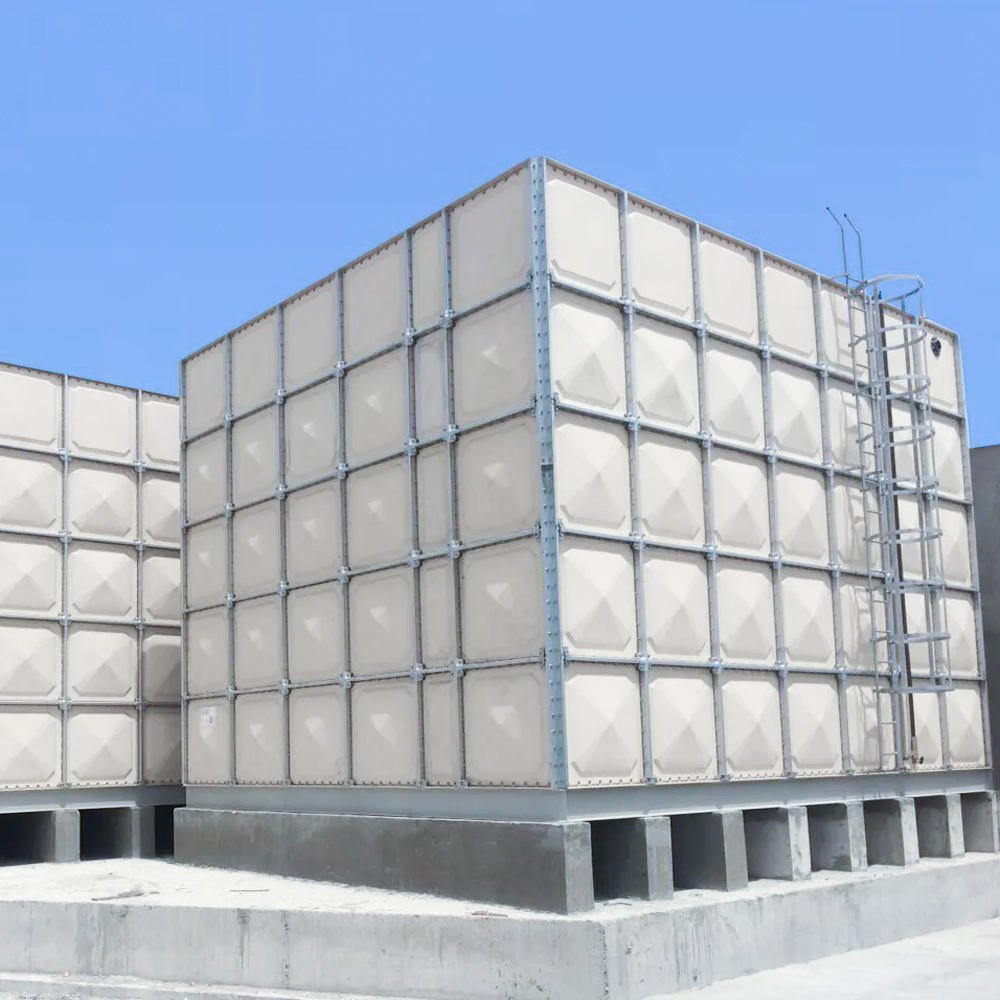
GRP sectional tanks are modular systems. Capacity is achieved by combining standard panels rather than selecting a single fixed shell. SMC panel water tank products illustrate how modular construction maps capacity to a real layout.
Common metric panel sizes in the GRP sectional tank industry include 1 m × 1 m, 1 m × 0.5 m, and 0.5 m × 0.5 m. Nominal capacity is calculated from internal length × width × height. Standard sectional GRP tanks are commonly erected up to approximately 4 m high in 0.5 m or 1 m increments, though some manufacturers offer taller configurations on request.
This means “tank size” has two layers: first, the required storage volume in litres or cubic metres; second, the physical sectional layout needed to achieve that volume within the available footprint, support arrangement, and site access constraints. A 100 m³ requirement is not one fixed answer, it could be lower and wider, taller and narrower, or split across two tanks for duty and standby, depending on roof capacity, plant access, and future expansion.
Why GRP sectional tanks suit EPC and contractor projects
GRP sectional tanks appeal to contractors less because of marketing language and more because of practical project logistics.
Modular transport and assembly
Panels ship flat and assemble on site, an advantage when a one-piece tank cannot pass through access points or when rooftop or basement installation is required.
Layout flexibility
Standard increments and connection positions can be adjusted to the actual installation location when columns, piping, or existing equipment constrain space.
Corrosion resistance
GRP does not corrode like unprotected steel. For potable use, a GRP potable water tank configuration is common when materials meet the hygiene requirements of the project.
Insulation is available as an option where thermal protection is needed; it is not a universal requirement for every climate. Review insulated GRP water tank options when the specification or climate calls for it.
Expansion readiness. Because the design is modular, some projects prepare foundations and piping for future capacity additions without replacing the original tank, which suits phased development common in African institutional and housing projects.
Installation and dimensions that affect selection
A tank can be correctly sized by volume and still be the wrong choice if installation conditions are overlooked.
Foundation
Sectional GRP tanks require a prepared, level foundation, which may be a concrete slab, support walls, or bearer beams depending on the base design and the tank manufacturer’s specification. Some installation guidelines call for very tight level tolerances across the entire foundation footprint.
Clearance and access
Manufacturer specifications often require maintenance clearance on all sides, figures of 450–500 mm per side are common references, though the exact requirement depends on the brand, flange type, and internal or external bolting. Clearance above the manway or inspection hatch must also be checked.
Size the tank with the installation envelope. A volume that fits the capacity calculation but not the physical space, or that leaves no room for valves, inspection, or panel replacement, is not a finished design.

Worked sizing examples
Hotel, 100 rooms
100 × 1.8 × 0.8 × 180 × 1.5 × 1.15 ≈ 44,700 L domestic storage. Then ask: separate fire reserve? rooftop vs ground? one tank or two for maintenance isolation?
Hospital, 200 beds
200 × 400 × 2 × 1.2 = 192,000 L. Modular layout often coordinates more easily than one massive shell where access is tight or compartmentalization is required. Confirm potable hygiene early.
Residential, 120 units
120 × 4 × 150 × 1 × 1.15 = 82,800 L. Limited roof load or risers may push storage ground-level or across two tanks.
If your project already has a capacity figure and you need a workable tank arrangement, ZENTVO can provide a free layout proposal based on your site conditions and project requirements.
Request a free tank layoutFive sizing mistakes that cost time and budget
- Sizing only for average demand. Average-day figures ignore peak demand, supply interruption, and occupancy variation. Projects that skip a buffer step often find themselves short during commissioning.
- Combining domestic and fire water without checking codes. Fire water reserve is usually governed by a separate flow-and-duration calculation. Merging it into a single domestic tank without consultant sign-off can create compliance problems that are expensive to fix after installation.
- Choosing volume before checking the installation envelope. Sectional tanks are flexible, but they still need foundation preparation, side clearance, overhead access, and maintenance space.
- Oversizing without considering turnover. More storage is not always better. Water that sits far longer than the system turns it over can develop quality issues, a concern that intensifies in warm climates.
- Ignoring future expansion. If a later phase is planned, a modular sectional approach is easier to expand than a fixed one-piece tank. Planning the foundation and piping upfront costs little compared to retrofitting later.
What information should you send to a GRP tank supplier?
If you want a supplier to move quickly from your inquiry to a usable tank recommendation, send more than just “We need a 100 m³ tank.”
Complete brief checklist
Typical information manufacturers need before moving from a rough capacity number to a sectional layout with dimensions, connections, and a realistic delivery timeline.
Engineering and drawings from ZENTVO
ZENTVO’s engineering team provides project-specific structural calculations, tank layout design, and detailed CAD drawings based on these inputs, typically within 24 hours of receiving a complete project brief. If you need to move from a capacity figure to a confirmed GRP specification, see engineering design support and share your full brief for the fastest path to a layout you can build from.
Ready to turn litres into a confirmed GRP layout?
Send your project type, estimated daily demand, storage days, fire reserve requirement, and available installation space to the ZENTVO engineering team. We typically return a project-specific tank layout with CAD drawings within 24 hours.