
FRP vs Stainless vs Concrete vs HDG: Comparison Guide
How FRP/GRP, stainless steel, concrete, and hot-dip galvanized (HDG) water tanks differ in cost, shipping, installation, corrosion, compliance, and 10–20 year total cost of ownership—so buyers can pick materials from project reality, not marketing.
Read the comparison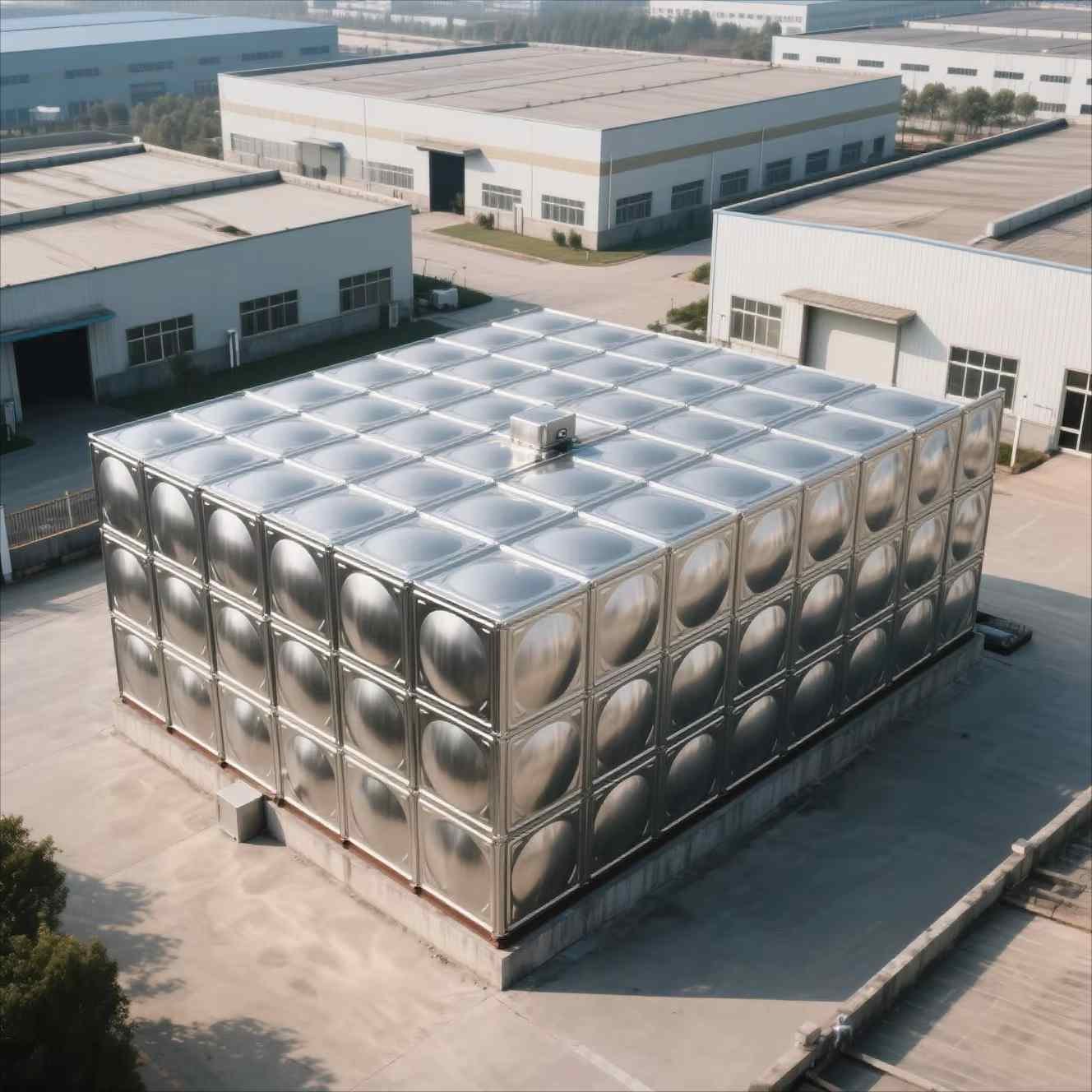
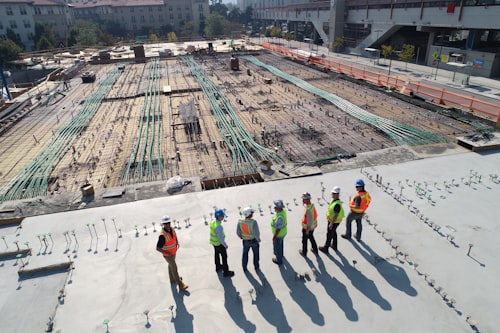
compared + HDPE
Choosing the right water tank material is one of the most consequential decisions in any building water supply, fire protection, or industrial storage project. The material you select affects not just the purchase price, but also transport logistics, installation method, corrosion exposure, maintenance burden, potable water compliance, and the total cost you will carry over 10 or 20 years. For context across water tank applications by industry, this article focuses on the four most commonly specified sectional and built tank materials: FRP/GRP, stainless steel, concrete, and hot-dip galvanized (HDG) steel. HDPE/plastic is addressed briefly, but is not the primary comparison.
No single material wins every scenario. The right choice depends on application, installation environment, compliance, and lifecycle priorities. This page helps project buyers, procurement, MEP contractors, and consulting engineers trade off real constraints—not brand slogans.
Why water tank material choice matters
In many procurement talks, material selection starts and ends with unit price per cubic meter—a shortcut that often creates cost surprises later. A lower purchase price can still mean more expensive shipping, harder installation, faster corrosion, or higher maintenance. A hotel rooftop has different structural, weight, and hygiene limits than a ground-level fire reserve. An underground municipal tank lives under site conditions that may be irrelevant to a factory process water system.
Installation method matters: a modular panel path has a different cost profile than a poured concrete system requiring formwork, curing, and waterproofing. Climate matters—coastal humidity, desert heat, tropical rainfall. Water chemistry—chloride, pH, temperature, treatment chemicals—drives how each material ages. Buyers who only compare list price often miss the real cost drivers: installation complexity, corrosion exposure, service life uncertainty, and future maintenance.
Quick comparison table
High-level, judgment-oriented view—not a certification sheet. Actual performance depends on design, build quality, water chemistry, and site conditions.
| Factor | FRP/GRP | Stainless steel | Concrete | HDG steel |
|---|---|---|---|---|
| Initial cost | Low to medium | High | Medium to high | Low to medium |
| Weight & transport | Light—easier to ship/handle | Moderate to heavy | Very heavy | Moderate to heavy |
| Corrosion | Strong in many water chemistries | Grade & water chemistry–dependent | Stable; risk from cracks / waterproofing | Heavily chemistry / coating–dependent |
| Potable suitability | With proper spec & certification | Strong hygiene perception | With lining & waterproofing | Project-by-project verification |
| Outdoor / UV | Depends on resin & surface protection | Generally strong | Strong (mass-based) | Strong if coating intact |
| Temperature | Moderate—check resin limits | High | High | Moderate—heat accelerates zinc use |
| Install complexity | Easier—modular assembly | Moderate to complex | Complex | Moderate |
| Maintenance | Low in most conditions | Low to moderate | Moderate to high | Moderate |
| Typical service life | Often 15–30+ years* | Often 20–50+ years* | Can exceed 30 years* | Highly variable—coating & water* |
| Best-fit scenarios | Rooftop, coastal, tropical, transport-limited, modular | Hygiene-critical, premium, high temp | Underground, large municipal, civil works | Fire reserve, industrial non-potable, cost-sensitive |
| Main limitations | UV if unprotected; resin limits; mfg. variance | Higher cost; wrong SS grade in chlorides | Long cycle; heavy; crack/leak risk | Zinc is consumable; not universal for potable |
*Condition-dependent. Use the table as a starting point, then align with the detailed sections and decision matrix below.
FRP/GRP water tanks — pros, cons & best fit
Key strengths
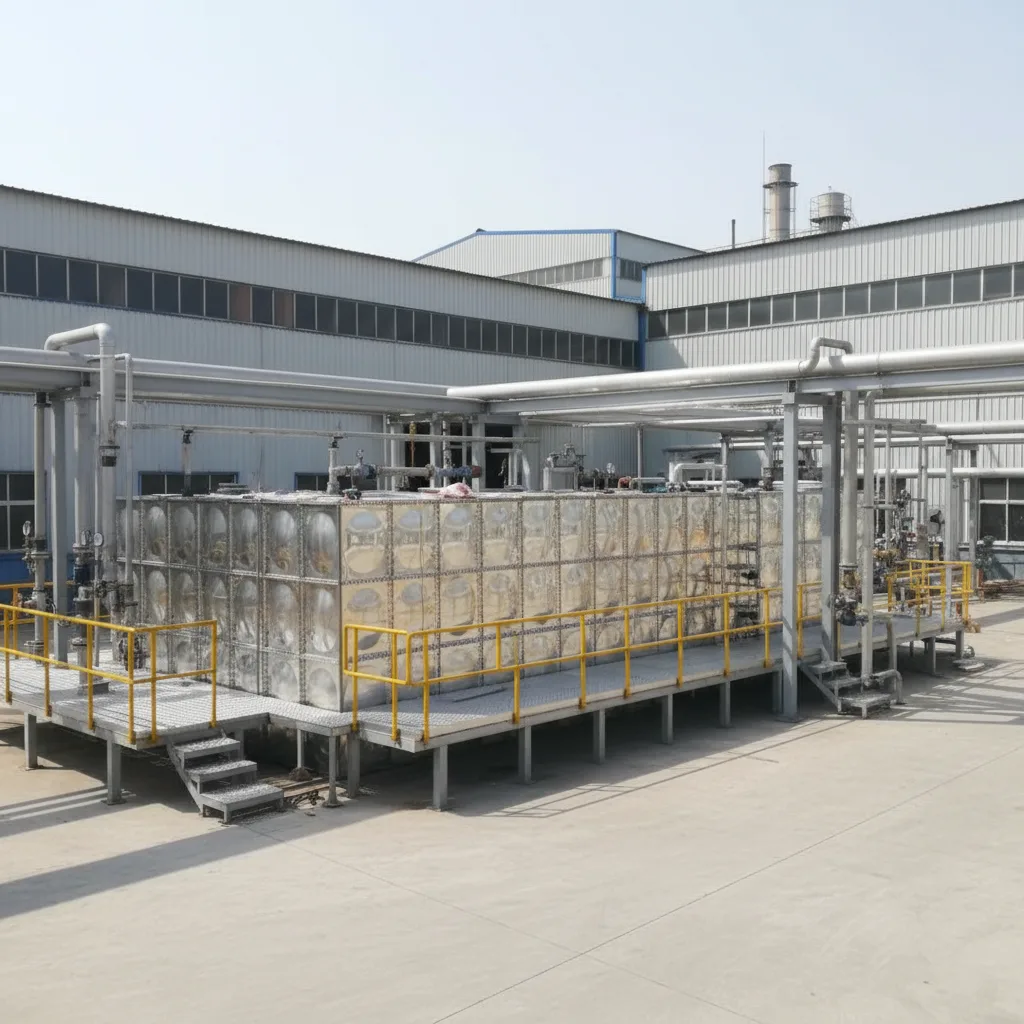
GRP sectional water tanks (the common factory product form for FRP/GRP) combine strong corrosion performance with a lightweight, modular build—without metallic rust in typical water service, and without relying on external coatings the way many steels do.
Weight is materially lower than concrete and most steel—helping shipping, container loading, and structural loading (especially rooftop and crane-limited sites). Modular flat-pack delivery supports urban, island, or access-constrained projects.
Main limitations
Outdoor/UV performance depends on resin, gel coat, and surface protection—ask for UV provisions for prolonged sun. Not every resin suits chemicals or elevated temperature; confirm before specification. Manufacturing quality varies: thickness consistency, resin-to-fiber ratio, joint sealing, and reinforcement all affect integrity. For very large capacity, demand credible structural justification—not only catalog sheets.
Best-fit scenarios
Strong when corrosion resistance + modular delivery + lower on-site burden matter more than maximum temperature headroom. Typical: tropical/humid regions, corrosive or coastal-adjacent environments, rooftops with weight and access limits, and projects prioritizing lower maintenance and modular logistics. For installation-type depth, also see how to choose a water tank for rooftop installation (dedicated post when live).
Stainless steel water tanks
Key strengths
Strong durability and hygiene perception—often the default in hospitals, hotels, food, and pharma. Temperature tolerance is higher than most composites and many plastics, simplifying warm/hot water paths. The material is recyclable with meaningful scrap value. Aesthetics help when the tank is visible in public or premium spaces.
Main limitations
Upfront cost is typically much higher than FRP/GRP and HDG. Fabrication and installation are more demanding—welding requires skills and post-weld control; bolted panels help but need disciplined assembly. Corrosion is not “absolute”: grade (304, 316, 316L, duplex), water chemistry, fabrication, and maintenance all matter. In chloride-rich or marine settings, wrong grade selection risks pitting/crevice attack.
Best-fit scenarios
Food and beverage, pharmaceutical, hygiene-sensitive buildings, long-term fixed installations, elevated water temperatures, and projects where a premium, clean image matters. For a hygiene-forward potable spec path, also review stainless steel water tank for potable water with your project standards.
Concrete water tanks
Key strengths
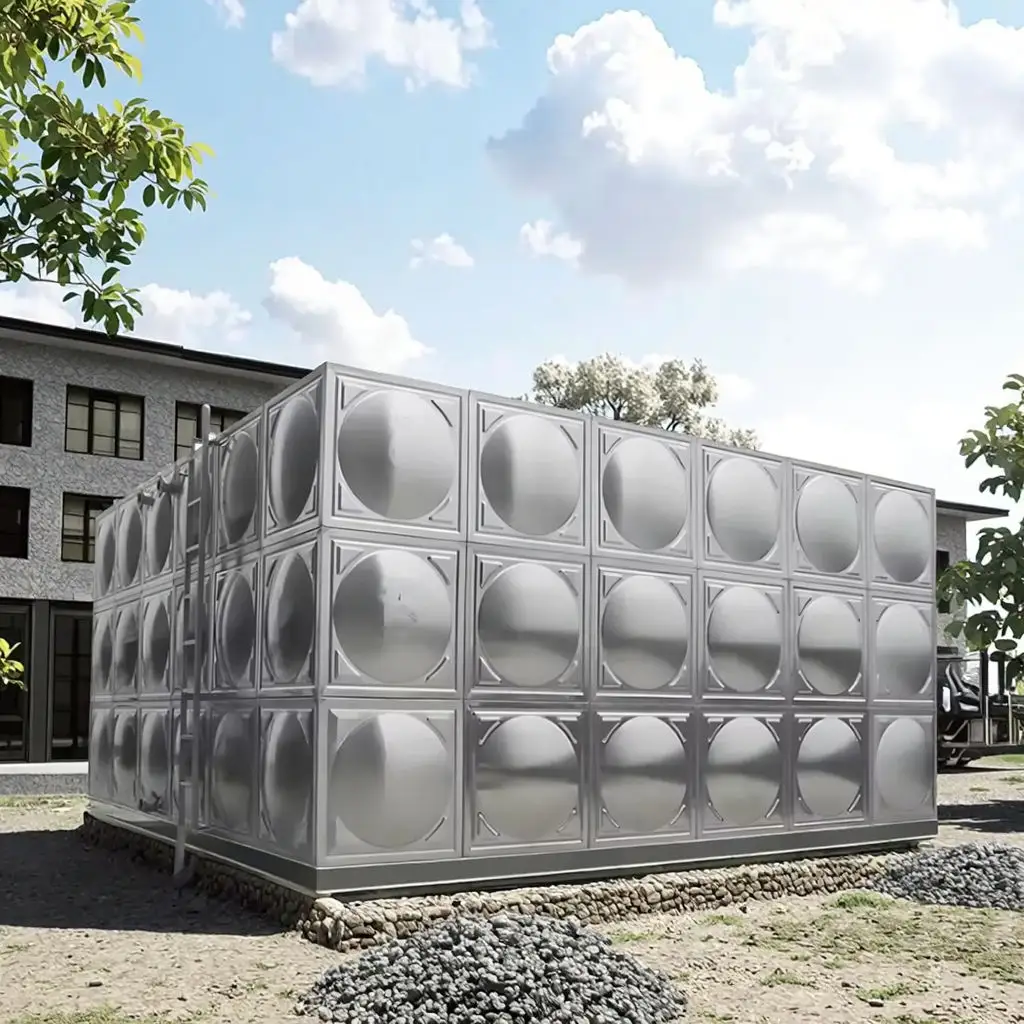
Mass and load-bearing fit buried and foundation-integrated work. In many markets, concrete is built with local labor and local supply—strategic for large municipal programs. For very large permanent reserves, well-designed and maintained concrete can be durable for decades.
Main limitations
Longer construction cycle: formwork, rebar, pour, cure, waterproofing. Highly site-dependent (soil, water table, equipment access, space). Cracks, leaks, and waterproofing failure can emerge over time; repair is often disruptive. Quality is tied to contractor execution—more variable than factory panel QC. Weight rules out most rooftop use.
Best fit
Underground storage integrated with building/civil work, large municipal installations where local quality is controllable, and where the tank is part of a reinforced structure from the design stage.
HDG (hot-dip galvanized) steel water tanks
Key strengths
HDG combines structural strength and moderate cost. Modular pressed-steel assembly mirrors FRP’s on-site build logic—useful for large capacity without cast-in-place work. For fire reserves and industrial non-potable storage, HDG is widely used where chemistry and temperature align with the coating. Consider the product line: hot-dip galvanized water tank configurations to match your scope.
Main limitations
The zinc coating is consumable—consumption rate depends on pH, dissolved oxygen, temperature, and treatment. Hot water accelerates coating stress. Coastal and high-chloride conditions deserve special scrutiny: salt air, seawater intrusion, and elevated water chlorides can shorten coating life versus benign freshwater. Industry references note much shorter service in seawater or high-chloride immersion; plan verification, not hope.
Potable suitability is not automatic—check local water chemistry, temperature, and regulations case by case. For a structured standards discussion on fire systems, also see fire protection water tank requirements (application page when live).
Coastal & chloride note: In aggressive immersion or high-chloride supplies, FRP/GRP or 316 stainless steel tank for coastal environments may offer more predictable long-term life than HDG. Always request manufacturer data for your water and atmosphere—generic brochures are not a substitute.
Best-fit scenarios
Fire protection reserves with compatible chemistry, industrial utility/process water in mild to moderate conditions, cost-sensitive large capacity after expected coating life is understood, and some large non-potable cases where galvanizing performance has been checked against actual water data. Weaker fit: coastal/high-chloride or elevated-temperature storage without engineering validation. When you have the water data in hand, align scope with a hot-dip galvanized water tank product line that matches the intended duty.
Where HDPE / plastic tanks fit
HDPE and other plastics are common in smaller residential, light commercial, and agricultural above-ground storage—light, corrosion-resistant, and budget-friendly at modest sizes. For commercial building supply, fire, municipal, larger industrial, or code-driven systems, FRP/GRP, stainless, concrete, and HDG are more often specified. Capacity, pressure, temperature limits, and scalability usually cap plastic in demanding projects.
Decision matrix — which material for which project?
No universal winner. Map your dominant constraint, then verify structurally, chemically, and with the AHJ as required.
| Scenario | Key priorities | Typical lead material | Why (short) | Verify before final pick |
|---|---|---|---|---|
| Hotel rooftop | Weight, modular delivery, potable, low maint. | FRP/GRP | Lower structural load; flat-pack; corrosion resistance in humidity | Roof load sign-off; potable cert for resin/assembly; Rooftop selection guide (post); local codes; UV if exposed |
| Factory ground | Capacity, durability, moderate cost | FRP/GRP or HDG | Modular; pick FRP if chemistry/corrosion is a concern, HDG if structure/cost match water data | Water chem analysis; design life; foundation; code for application |
| Underground | Structure, permanence, buried | Concrete | Mass suits soil loads; integrates with civil | Waterproofing + contractor track record; groundwater; maintenance access; seismic if applicable |
| Fire protection reserve | Code, reliability, fast fill/drain, approvals | HDG or FRP/GRP | Common in fire; HDG for strength; FRP for corrosion and lighter install | Fire protection water tank requirements; AHJ/FD; NFPA/EN/BS as applicable*; water temp & connections |
| Chemical / process | Chemical compatibility, corrosion | FRP/GRP or SS 316 | FRP for many water chemistries; SS for selected aggressive conditions with correct fab | Concentration, temperature, batch vs continuous; resin/alloy sign-off; containment |
| Temporary jobsite | Speed, portability, cost | HDG or FRP/GRP | Modular, reusable; HDG rugged, FRP lighter | Duration, relocation plan, site water, reuse inspection |
| Coastal / island | Salt, logistics, corrosion | FRP/GRP | Non-metallic avoids salt-air issues; light panels for remote delivery | UV/weathering; wind loads; packing plan; potable path if required |
| Hot desert | High ambient temp, UV, thermal cycling | FRP+UV or stainless | FRP with proper resin/UV; SS tolerates high temperature | Resin temp limits; insulated water tank options if control needed; joint movement & sand abrasion |
*Jurisdictions differ—confirm the framework your AHJ enforces. This matrix is general guidance, not a substitute for code review.
Need help choosing the right tank material? Send application, installation location, capacity, and target market—our team can return a project-based material comparison, typically within 24 hours.
Request a project consultationTotal cost of ownership (TCO)
Purchase price is the most visible cost, but rarely the only large one. Meaningful comparison spans the full project lifecycle.
What TCO includes
Initial equipment cost; transport; installation and civil work; cumulative maintenance; major repair or replacement risk; disruption/downtime risk; and salvage or residual value.
TCO formula
TCO = Initial + Installation + Cumulative Maintenance + Major Repair/Replace − Residual Value
Illustrative model only — the indices below are for directional comparison, not a quotation or certified study. FRP/GRP is indexed at 100 as baseline. Ranges reflect project variability (labor, climate, water chemistry, grade). Coastal / high-temp / chemical sites can move HDG and concrete maintenance materially. For preparation steps before RFQ, read what to prepare before requesting a water tank quotation.
10-year TCO index (illustrative)
| Factor | FRP/GRP | Stainless | Concrete | HDG |
|---|---|---|---|---|
| Initial cost index | 100 | 180–220 | 140–170 | 90–110 |
| Installation index | 100 | 130–160 | 200–260 | 100–120 |
| Annual maintenance index | 100 | 100–120 | 140–180 | 120–150 |
| Major repair / replace risk (10 yr) | Low | Low | Low to mod. (waterproofing) | Low to mod. (coating) |
| Residual value | Low | Moderate (scrap) | Very low | Low |
| Est. 10-yr TCO index | ~100 | ~155–185 | ~160–200 | ~95–120 |
20-year TCO index (illustrative)
| Factor | FRP/GRP | Stainless | Concrete | HDG |
|---|---|---|---|---|
| Initial cost index | 100 | 180–220 | 140–170 | 90–110 |
| Installation index | 100 | 130–160 | 200–260 | 100–120 |
| Cum. maintenance (20 yr) | 100 | 110–140 | 180–240 | 150–200 |
| Major risk (20 yr) | Low | Low | Moderate (waterproofing likely) | Mod. to high (re-galv / replace possible) |
| Residual value | Low | Moderate | Very low | Low |
| Est. 20-yr TCO index | ~100 | ~145–175 | ~170–220 | ~110–150 |
Caveats: illustrative only. Stainless longevity + scrap can narrow TCO in some baselines. HDG can win when water is benign and coating life is long. Concrete can win when already embedded in civil works. Build your own TCO with local cost inputs and verified chemistry.
Frequently asked questions
Request a project-based recommendation
Comparing FRP, stainless, concrete, and HDG? Send application, capacity, location, and water source—engineering typically responds within 24 hours. Need docs before you reach out? Use what to prepare before requesting a water tank quotation.
Send your project details — include codes, water analysis if available, and target delivery/price band.
Send your project detailsCustom TCO estimate — share capacity, location, and application; we can align assumptions to your site and standards.
Get a custom TCO estimateFrom comparison to a precise quotation
Material choice is the start—ZENTVO can connect specs to a documented scope, compatible accessories, and export-ready delivery when needed.
Contact engineering