
By the ZENTVO Engineering Team — a water storage engineering group designing modular stainless steel, galvanized, GRP/FRP and fire reserve tank systems for municipal, building-services and industrial projects in 60+ countries, with ISO 9001 & 14001 certified systems and a 24-hour engineering response workflow.
TL;DR — Stainless Steel Bolted Tank Sizing in 6 Lines
- A 100 m³ “nominal” tank is rarely a 100 m³ usable reserve — freeboard, outlet height and operating allowance typically consume 8–12 % of nominal volume.
- Panel thickness ranges from 1.5 mm at the roof to 5.0 mm at the bottom course — driven by hydrostatic pressure (9.81 kPa per metre of depth).
- Use 304 / 304L when chloride is < 200 mg/L and disinfection is controlled; switch to 316 / 316L for coastal, hospital, fire-reserve or higher-chloride duty.
- Foundation flatness target: ±3 mm over 3 m, ±5 mm overall — uneven base = gasket leakage.
- A 100 m³ water reserve loads the slab with ~100 tonnes of water alone; foundation review is non-negotiable.
- Send ZENTVO a 5-input RFQ (usable capacity, room dimensions, water chemistry, nozzle schedule, access) for a project-specific drawing within 24 hours.
Why Reading This Guide Saves You a Re-Design
For most potable-water, commercial-building and industrial utility projects, you need to size a stainless steel bolted tank from usable volume first, then convert it into nominal volume by adding freeboard, dead storage, outlet submergence and maintenance access. A tank labeled 100 m³ is not automatically a 100 m³ usable reserve — if the outlet sits 150 mm above the floor and the overflow needs 200 mm freeboard, a 5 m × 5 m × 4 m tank loses about 8.75 m³ before piping and operating levels are even considered.
Scope of this guide: capacity geometry, usable-volume allowances and panel-thickness planning before the GA drawing. For site assembly and leak-testing steps, use the installation checklist; for a single 50,000-litre footprint, use the 50,000 litre size guide.
After reading this guide you can hand your structural engineer a usable-volume number, a panel-thickness range, a foundation load figure and an RFQ checklist — without redoing the math twice.
ZENTVO normally starts a stainless steel bolted tank quotation with five inputs: usable capacity, tank room dimensions, water chemistry, nozzle schedule and installation access. These five inputs decide the tank footprint, height, panel thickness range, stainless grade, foundation load and the drawings needed before production.
If you already have a capacity and tank room size, request a quote with the dimensions, water duty and nozzle list so ZENTVO can review the tank geometry before the purchase order is issued.
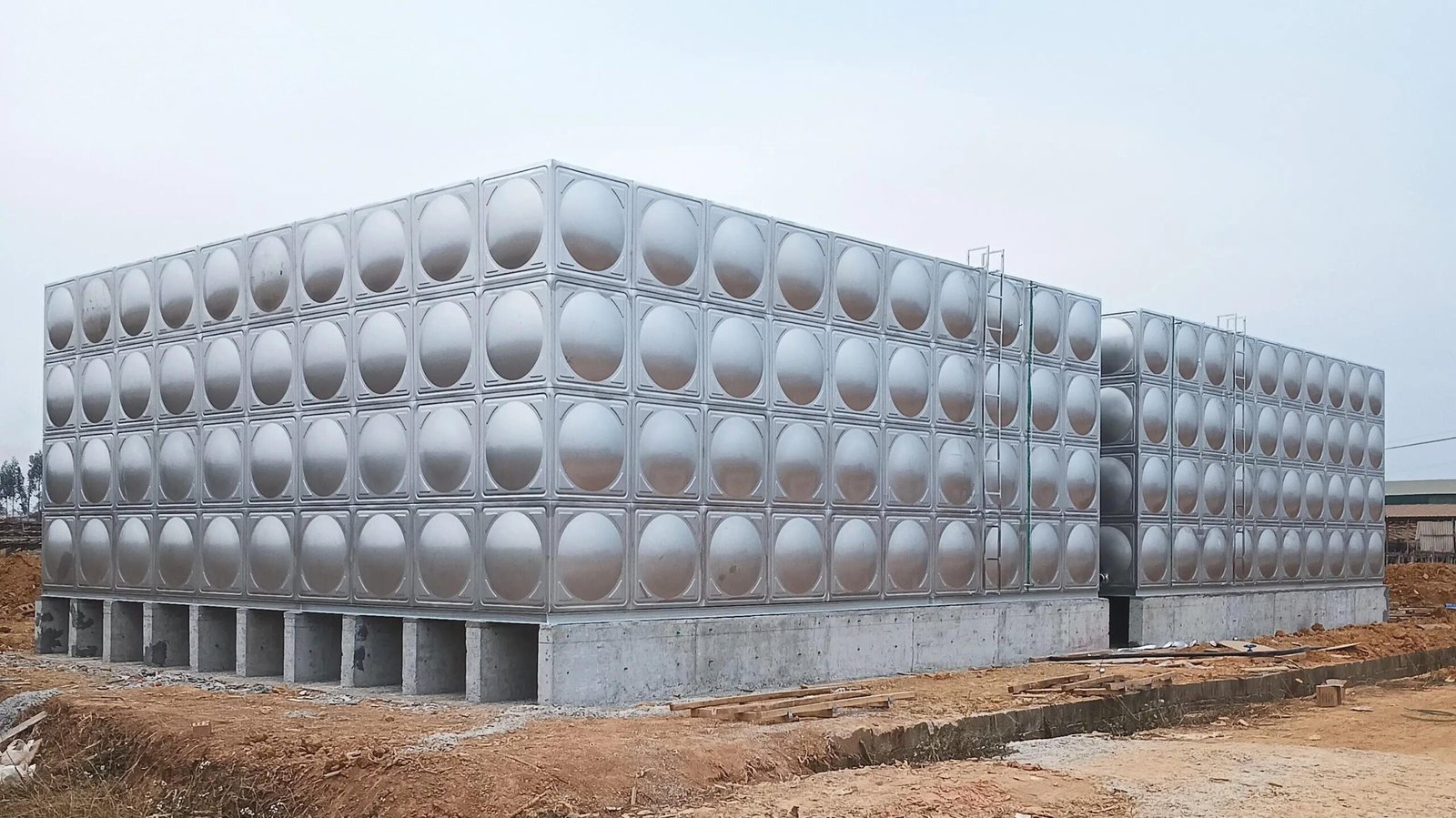
1. Quick Sizing Rules for Stainless Steel Bolted Tanks
A stainless steel bolted tank should be selected by usable volume, not by catalog volume. Use this table as the first filter before any drawing review.
| Decision item | Practical starting point | Why it matters |
|---|---|---|
| Minimum freeboard | 150–300 mm | Prevents overflow during filling and gives room for high-level control. |
| Dead storage below outlet | 100–200 mm | Keeps sediment away from the outlet and allows drain-down planning. |
| Typical modular panel | 1,000 × 1,000 mm or 1,220 × 1,220 mm | Panel size controls shipping, access and installation time. |
| Common height range | 1–5 m | Taller tanks reduce footprint but increase hydrostatic pressure and reinforcement. |
| Filled water mass | 1,000 kg per m³ | A 100 m³ tank loads the slab with roughly 100 tonnes of water before tank weight. |
| Foundation flatness target | ±3 mm over 3 m, ±5 mm overall | Uneven support changes gasket compression and leakage risk. |
| Access clearance | 600 mm preferred around sides and roof | Allows bolting, cleaning, inspection and nozzle maintenance. |
| Typical operating temperature | 5–40 °C for water duty | Above 60 °C, review insulation and gasket compatibility. |
Use the Stainless Steel Bolted Water Tank product page for the full system configuration, and use this guide to prepare the engineering data behind the RFQ.
2. How to Convert Demand Into Tank Volume
Usable tank volume equals the water the project can actually draw without exposing outlets, starving pumps or spilling through the overflow.
Source: this section is an illustrative project sizing method using standard SI volume calculation; project approval still belongs on the final GA drawing.
Use this first-pass formula:
nominal volume = usable volume + freeboard volume + dead-storage volume + operating allowance
For a rectangular bolted tank:
volume (m³) = length (m) × width (m) × water depth (m)
2.1 Worked Example: 100 m³ Usable Storage for a Commercial Building
Assume the buyer needs 100 m³ usable water for a commercial building potable-water buffer tank.
Inputs: – Target usable volume: 100 m³ – Trial footprint: 5 m × 5 m – Freeboard: 0.20 m – Outlet dead storage: 0.15 m – Operating allowance for level control: 0.10 m
Calculation:
non-usable depth     = 0.20 + 0.15 + 0.10        = 0.45 m
          non-usable volume    = 5 × 5 × 0.45              = 11.25 m³
          nominal volume       = 100 + 11.25               = 111.25 m³
          trial tank height    = 111.25 / (5 × 5)          = 4.45 m
Recommendation: Do not quote a nominal 100 m³ tank for this duty. Quote a 5 m × 5 m × 4.5 m tank (≈ 112.5 m³ nominal), or revise the footprint to 6 m × 5 m × 3.8 m if ceiling height is limited.
3. Size Matrix for Common Rectangular Bolted Tanks
The best tank geometry balances footprint, ceiling height, panel count and maintenance access. The matrix below is calculated from length × width × height and rounded for practical modular-panel planning.
| Required usable volume | Example nominal geometry | Approx nominal volume | Typical application | Main check before quotation |
|---|---|---|---|---|
| 10 m³ | 2 m × 2 m × 3 m | 12 m³ | Small plant room or process buffer | Door width and roof access. |
| 30 m³ | 3 m × 4 m × 3 m | 36 m³ | Hotel, school or light industrial supply | Slab load near 30 tonnes plus tank weight. |
| 50 m³ | 5 m × 4 m × 3 m | 60 m³ | Building potable water or fire make-up | Nozzle schedule and drain location. |
| 100 m³ | 5 m × 5 m × 4.5 m | 112.5 m³ | Commercial building or municipal buffer | Ceiling, tie-rod layout and access clearance. |
| 200 m³ | 8 m × 6 m × 4.5 m | 216 m³ | Municipal, factory or campus supply | Foundation bearing and seismic/wind check. |
| 500 m³ | 10 m × 10 m × 5.5 m | 550 m³ | Infrastructure and process water storage | Engineering review for reinforcement and foundations. |
| 1,000 m³ | 16 m × 12 m × 5.5 m | 1,056 m³ | Municipal reservoir or industrial reserve | Full structural review + seismic/wind report. |
For mid-size dimensional examples, the 50,000 Litre Rectangular Water Tank Size guide gives a more detailed footprint breakdown.
4. Panel Thickness Is Driven by Water Depth
Panel thickness increases toward the bottom because hydrostatic pressure increases with depth.
Source: hydrostatic pressure values use the standard water-pressure approximation of 9.81 kPa per metre of water depth; thickness ranges are preliminary ZENTVO engineering planning ranges.
Hydrostatic pressure formula:
pressure (kPa) = 9.81 × water depth (m)
At 1 m depth, water pressure is about 9.81 kPa. At 5 m depth, the bottom course sees about 49.05 kPa before safety factors, panel geometry and reinforcement are applied. That is why a 5 m tall tank cannot use the same panel schedule from top to bottom.
| Water depth zone | Typical stainless panel route | Engineering note |
|---|---|---|
| Roof and top course | 1.5 – 2.0 mm | Low pressure, but roof load and access still matter. |
| Mid courses | 2.0 – 3.0 mm | Reinforcement layout controls deflection. |
| Bottom courses | 3.0 – 5.0 mm | Highest water pressure and gasket load. |
| Nozzle zones ≥ DN80 | Local reinforcement plate | Pipe load should not pull directly on panel skin. |
| Tall tanks above 4 m | Tie rods or external reinforcement | Deflection control protects gasket compression. |
These are planning ranges, not a substitute for ZENTVO’s final drawing. Final thickness depends on tank height, stainless grade, panel pressing (embossed vs flat), bracing, wind load, seismic zone, roof live load and project standard.
5. Choose 304 or 316 Before Finalizing the Size
Stainless grade affects both tank cost and risk, so it should be selected before the final offer — not after.
Source: chloride screening follows Nickel Institute and World Stainless guidance, cross-referenced with ZENTVO’s 304 vs 316 Stainless Steel Water Tanks guide. Final selection should always be confirmed with project water chemistry.
Use 304 / 304L for normal indoor potable water when chloride is below about 200 mg/L, residual chlorine is controlled and inspection access is good. Use 316 / 316L for coastal sites, higher chloride water, critical public-water storage or harder cleaning chemistry — 316 has been shown to handle chlorides well above 250 ppm under conservative conditions.
| Project condition | 304 / 304L route | 316 / 316L route |
|---|---|---|
| Indoor potable water below 200 mg/L chloride | ✅ Usually suitable | Optional for critical facilities. |
| Coastal or rooftop tank | ⚠️ Review carefully | ✅ Preferred for panels, fasteners and external accessories. |
| Hospital or municipal potable reserve | Possible with clean chemistry | ✅ Often preferred — failure consequence is higher. |
| Fire reserve with long stagnation | ⚠️ Check cleaning plan and water treatment | ✅ Preferred when inspection interval is long. |
| Industrial utility water | Requires water analysis | Requires water analysis; 316 is not automatic if chemistry is aggressive. |
| Chlorinated swimming-pool make-up | ❌ Not recommended | ⚠️ Even 316 needs careful review at high free-chlorine. |
Engineering note: Fabrication quality often matters as much as alloy grade. Per ASTM A380 and Nickel Institute guidance, embedded iron contamination, poor weld cleanup and inadequate post-fabrication cleaning can degrade a 316 tank below the expected service life. Every ZENTVO panel passes surface cleaning and contamination-control inspection before shipment.
6. Bolted vs Welded vs GRP — Sizing Differences Buyers Should Know
This is the most-asked comparison from EPC buyers. The table below is format-only — final selection depends on water chemistry, site conditions and lifecycle cost.
| Criterion | SS Bolted (Modular) | SS Welded (One-Piece) | GRP / FRP Sectional |
|---|---|---|---|
| Max practical capacity | Up to 1,000+ m³ | Up to 5,000+ m³ | Up to 1,000 m³ |
| Site access | ✅ Modular panel bundles — fits standard doors and lifts | ❌ Needs crane / road access for one-piece delivery | ✅ Sectional, similar to bolted |
| On-site assembly time (100 m³) | 3–7 days | 7–15 days (site welding) | 3–7 days |
| Future expansion | ✅ Add or replace panels | ❌ Difficult — re-welding required | ⚠️ Possible but limited |
| Corrosion resistance (potable) | ✅ Excellent (304/316) | ✅ Excellent (304/316) | ✅ Good (food-grade resin) |
| Hot water / steam compatibility | ✅ Up to 60 °C (gasket-limited) | ✅ Up to 80 °C+ | ⚠️ Limited (~50 °C) |
| Repair after leakage | ✅ Replace panel + gasket | ❌ Drain + site weld | ⚠️ Patch repair |
| Typical service life | 20–30 years (304), 25–35 years (316) | 25–40 years | 15–25 years |
| Drinking-water certification | NSF/ANSI/CAN 61, WRAS BS 6920 | NSF/ANSI/CAN 61 | WRAS BS 6920 (resin-dependent) |
| Best fit | Building services, hospitals, fire reserve, restricted-access sites | Large municipal / industrial | Cost-sensitive building tanks |
For a broader material and construction comparison, see Bolted vs Welded Steel Water Tanks. This sizing guide stays focused on stainless modular geometry and panel planning.
7. Foundation and Load Check
Foundation load is the fastest way to discover that a proposed tank size will not fit the building.
Water weighs 1,000 kg/m³, so a tank with 200 m³ nominal capacity contains about 200 tonnes of water. If the tank footprint is 8 m × 6 m, the water load alone is:
water load per floor area = 200,000 kg / 48 m² ≈ 4,167 kg/m² (≈ 40.9 kN/m²)
That load must be checked by the structural engineer before order approval. For quotation-stage review, the tank supplier provides filled weight, base reactions, anchor points and panel layout, while the building engineer confirms slab capacity, ring beam, settlement and drainage.
| Foundation risk | Numeric trigger | Design response |
|---|---|---|
| Suspended slab | Any tank above 10 m³ | Structural review before quotation. |
| Tall narrow tank | H/L ratio > 1.0 | Check lateral stability and access. |
| Outdoor tank | Per local wind code (e.g. ASCE 7 / EN 1991) | Add anchors and wind/seismic review. |
| Fire or municipal tank | Usable capacity is contractual | Show low-water level and unusable volume on GA drawing. |
| Uneven base | More than ±5 mm overall | Correct the base before panel assembly. |
| Seismic zone | Local PGA / Z factor | Confirm anchor design and tie-rod schedule. |
8. Nozzles and Access Change the Real Size
Nozzle positions should be confirmed before production because they change usable volume, maintenance access and pipe routing.
Source: nozzle ranges are preliminary ZENTVO RFQ planning ranges; final nozzle DN and reinforcement are set on the approved GA drawing.
At minimum, a stainless steel bolted tank needs inlet, outlet, overflow, drain, vent and manhole positions. Fire reserve tanks also need low-water alarm, pump suction geometry and anti-vortex protection. Potable tanks need safe cleaning entry, internal drainage and a layout that reduces stagnant corners.
| Connection | Typical range | Sizing note |
|---|---|---|
| Inlet | DN50 – DN200 | Match fill rate and avoid jetting sediment into outlet zone. |
| Outlet | DN50 – DN300 | Set outlet height after usable-volume calculation. |
| Overflow | ≥ inlet size | Prevents tank overpressure or room flooding. |
| Drain | DN50 – DN150 | Needs floor drain route and maintenance plan. |
| Vent | Sized for fill/drain rate | Screened vent protects water quality. |
| Manhole | 600 mm clear (≥ 500 mm minimum) | Needed for inspection and cleaning. |
| Anti-vortex plate (fire/critical) | Per pump suction DN | Prevents air entrainment at low water level. |
| Level sensor port | DN25 – DN50 | Locate away from inlet jet for accurate reading. |
The Water Tank Nozzle Schedule Guide is the supporting article to use when the mechanical contractor is ready to mark connections.
9. Lifecycle Matrix for Stainless Bolted Tanks
The lowest first price is not always the lowest lifecycle cost.
Source: lifecycle values are planning ranges for procurement comparison; final service life depends on water chemistry, inspection interval, stainless grade, gasket condition and installation environment.
| Decision path | Typical design life target | Inspection interval | Common hidden cost | Better specification action |
|---|---|---|---|---|
| 304 indoor potable tank | 20–30 years | 12 months | Oversized tank causing low turnover | Size to real daily demand plus reserve. |
| 316 coastal potable tank | 25–35 years | 6–12 months | Mixed-grade bolts or ladders corroding first | Keep wetted and exposed accessories consistent. |
| Tall 5 m modular tank | 20–30 years | 12 months | Foundation movement affecting gaskets | Require foundation flatness report. |
| Fire reserve stainless tank | 20–30 years | 6 months visual, annual functional | Stagnant sediment and low-water alarm failure | Add drain, alarm and cleaning plan. |
| Industrial utility tank | Project-specific | 3–12 months | Chemistry changes after commissioning | Request updated water analysis before final material choice. |
Corrosion, leakage and access problems usually start from incomplete project information, not from the tank format itself. A clear RFQ saves more time than a longer quotation.
10. Standards and References to Name in the Specification
The tank specification should separate drinking-water health effects, structural design, coating, access safety and quality management.
| Reference | Where it helps |
|---|---|
| NSF/ANSI/CAN 61 | Health-effects evaluation for drinking-water-contact products and components.1 |
| WRAS BS 6920 | UK route for evaluating non-metallic materials in contact with wholesome water.2 |
| AWWA D103 | Factory-coated bolted steel water tank reference (bolted carbon-steel benchmark).3 |
| AWWA D100 | Welded carbon steel tank reference — for bolted vs welded comparison.3 |
| AWWA D102 | Coating steel water-storage tanks — for stainless vs coated steel comparison.3 |
| ASTM A380 | Cleaning, descaling and passivation of stainless steel — critical for fabrication quality.4 |
| ASTM A240 | Standard specification for stainless steel plate, sheet and strip used in tank panels.5 |
| ISO 9001 | Quality management system reference for manufacturing control.6 |
| ISO 14001 | Environmental management — increasingly required in public tenders.7 |
| BS EN ISO 1461 | Hot-dip galvanized reference for the galvanized alternative — not stainless panels.8 |
For a stainless steel bolted water tank, the important point is not to list standards casually. State which parts of the tank, documents or inspections each standard controls.
11. RFQ Inputs ZENTVO Needs
Send these details when requesting a stainless steel bolted tank quotation — and you’ll typically receive a layout sketch and panel schedule within 24 hours.
Capacity & geometry – Required usable capacity in m³ or litres. – Maximum tank room length, width and height. – Door, lift, stair and crane access dimensions.
Service conditions – Installation environment: indoor, outdoor, rooftop, basement or coastal. – Water duty: potable, fire reserve, industrial utility or process water. – Water analysis: chloride in mg/L, pH, temperature and disinfectant method. – Preferred stainless grade: 304, 316 or recommendation needed.
Mechanical scope – Nozzle schedule: inlet, outlet, overflow, drain, vent, manhole and instruments. – Flange standard: ANSI / EN / JIS / GB. – Required accessories: ladder, level indicator, insulation, platform, internal partition or access hatch.
Project & logistics – Local standard or consultant specification. – Foundation type and whether slab load is already approved. – Destination country, delivery deadline and documentation needs. – Preferred Incoterm: EXW / FOB / CIF / DAP.
With those inputs, ZENTVO can return a tank layout, panel schedule, nozzle arrangement and quotation path instead of guessing from a single capacity number.
👉 Request a Technical Proposal — typical engineering reply within 24 hours.
12. FAQ — Stainless Steel Bolted Tank Sizing
What is the best size for a stainless steel bolted tank?
The best size is the smallest geometry that gives the required usable volume after freeboard, outlet height and operating allowance are deducted. For a 100 m³ usable requirement, a nominal 100 m³ tank is usually too small — a 110–115 m³ nominal tank is often closer after non-usable volume is counted. ZENTVO recommends quoting a 5 m × 5 m × 4.5 m (112.5 m³ nominal) tank for a 100 m³ usable duty.
What is the difference between nominal and usable volume?
Nominal volume is length × width × height of the tank shell. Usable volume is what you can actually draw out without exposing outlets or spilling. The difference (typically 8–12 % of nominal) is freeboard + dead storage + operating allowance. Always specify which one the contract requires — most disputes start here.
How thick are stainless steel bolted tank panels?
Stainless steel bolted tank panels commonly range from about 1.5 mm in low-pressure roof or upper zones to 5.0 mm in lower high-pressure zones. Final thickness depends on tank height, panel design, reinforcement, stainless grade, wind/seismic load and project standard, so it must be confirmed on the GA drawing.
Is a taller stainless steel bolted tank cheaper?
For a height-constrained site, a taller tank reduces footprint only when the foundation, ceiling and reinforcement schedule still fit the project. Higher water depth increases bottom pressure, panel thickness, tie-rod demand and foundation reaction. If ceiling height, access or slab load is tight, a lower and wider tank may be easier to install and maintain.
How many panels does a 100 m³ bolted tank need?
With 1 × 1 m panels and a 5 m × 5 m × 4.5 m geometry, you need roughly 25 floor + 25 roof + 90 wall = 140 panels, plus tie-rods, bolts, sealant and accessories. With 1.22 × 1.22 m panels, the count drops to about 95–100 panels. The exact count is confirmed on the GA drawing.
Should I choose 304 or 316 for the same tank size?
Choose 304 for normal indoor potable water with chloride below about 200 mg/L and controlled disinfection. Choose 316 for coastal, higher-chloride, hospital, municipal or critical storage. If water chemistry is aggressive, compare stainless with GRP/FRP or coated steel instead of assuming 316 is enough.
Can a stainless bolted tank be installed on a rooftop?
Yes — rooftop installation is one of the strongest use cases for a bolted modular tank because panels fit through standard stairwells and lifts. The rooftop slab must be checked for filled water load (1 tonne per m³), and for outdoor or coastal rooftops ZENTVO usually recommends 316 / 316L for panels and fasteners.
How long does it take to install a 100 m³ stainless bolted tank?
A 100 m³ ZENTVO bolted tank typically takes 3–7 days for on-site assembly with a 2–3 person crew, plus 1–2 days for hydrostatic testing and commissioning. Welded one-piece tanks of the same size usually require 7–15 days of site welding plus inspection.
What documents should come with a stainless steel bolted tank?
Request a general arrangement drawing, panel layout, nozzle schedule, foundation load data, material certificates (mill test reports), gasket and accessory specifications, packing list, installation manual and inspection checklist. For potable water, ask for drinking-water-contact evidence (NSF 61 / WRAS) for the wetted parts — especially gaskets, sealants and accessories.
What is the lead time for a ZENTVO stainless bolted tank?
For standard 304/316 panel sizes and common nozzle arrangements, ZENTVO’s typical lead time is 4–6 weeks from approved drawing to ex-works. Custom geometries, special grades or extended accessory scope can extend this to 6–10 weeks. Drawing approval usually takes 5–7 working days after RFQ submission.
Review Record
This article was reviewed by the ZENTVO water storage engineering team on 2026-06-25 for sizing logic, stainless grade selection, standards references, RFQ completeness and internal link fit. Content reflects ZENTVO’s standard engineering workflow for stainless steel bolted water tank projects delivered across 60+ countries under ISO 9001 & 14001 certified systems.
About the author — The ZENTVO Engineering Team is a multi-disciplinary group covering mechanical design, materials engineering, fabrication QC and project delivery for modular stainless steel, galvanized, GRP/FRP and fire reserve tank systems. Reviews follow ZENTVO’s engineering-led workflow with 24-hour technical response, CAD/GA drawing packages and submittal support before fabrication begins.
Sources
-
NSF, “NSF/ANSI/CAN 61: Drinking Water System Components – Health Effects,” https://www.nsf.org/newsroom_pdf/NSF-ANSI_61_watemarked.pdf ↩
-
WRAS Approvals, “BS 6920 testing requirements,” https://www.wrasapprovals.co.uk/downloads/public_area/documents/213_ver4_pub.pdf ↩
-
American Water Works Association, standards and manuals for steel water storage tanks, https://www.awwa.org/ ↩↩↩
-
ASTM International, “ASTM A380/A380M – Standard Practice for Cleaning, Descaling and Passivation of Stainless Steel Parts, Equipment and Systems,” https://store.astm.org/a0380_a0380m-25.html ↩
-
ASTM International, “ASTM A240/A240M – Standard Specification for Chromium and Chromium-Nickel Stainless Steel Plate, Sheet, and Strip for Pressure Vessels and for General Applications,” https://store.astm.org/a0240_a0240m-26.html ↩
-
ISO, “ISO 9001 Quality management systems,” https://www.iso.org/iso-9001-quality-management.html ↩
-
ISO, “ISO 14001 Environmental management systems,” https://www.iso.org/iso-14001-environmental-management.html ↩
-
ISO, “ISO 1461 Hot dip galvanized coatings on fabricated iron and steel articles,” https://www.iso.org/standard/81435.html ↩
Need a Tank Proposal?
Send capacity, water chemistry, site conditions and required standards. ZENTVO engineers can review the application and return a practical tank recommendation.
Send Requirements