
By the ZENTVO Engineering Team — a water storage engineering group designing modular stainless steel, galvanized, GRP/FRP and fire reserve tank systems for commercial, municipal and industrial projects in 60+ countries, with ISO 9001 & 14001 certified systems and a 24-hour engineering response workflow.
TL;DR — Stainless Steel Water Tank Price in 6 Lines
- Indicative ex-works price (2026): USD 180–320 / m³ for 304 modular bolted tanks; USD 230–420 / m³ for 316 — at 50–200 m³ scale.
- A 100 m³ 304 bolted tank ex-works typically lands at USD 18,000–28,000; a 316 equivalent at USD 22,000–35,000 (≈ +25–30 %).
- Capacity is the single biggest driver — but only because it sets panel count, freight volume and foundation reaction.
- Hidden costs that move quotes by 10–25 %: nozzle reinforcement, ladder/platform, level instruments, insulation, freight Incoterm and potable certification.
- 304 vs 316 net price gap: typically +17–30 % on like-for-like scope — only worth it above ~200 mg/L chloride, coastal, hospital or fire-reserve duty.
- For an apples-to-apples comparison, send all suppliers the same RFQ checklist (capacity + room + nozzle schedule + water analysis + Incoterm).
⚠️ Note on ranges in this article: all USD figures are indicative market ranges for budget screening only — based on observed 2024–2026 mill prices for ASTM A240 stainless plate and modular bolted tank tendering data. Real prices vary by grade, accessories, freight, Incoterm, lead time and destination country. Request a ZENTVO quotation for project-specific pricing.
1. The Short Answer: How Much Does a Stainless Steel Water Tank Cost?
Stainless steel water tank price is driven by usable volume, stainless grade, panel thickness, tank shape, nozzle schedule, accessories, freight volume and installation access. For the same nominal 100 m³ capacity, a simple 304 indoor rectangular tank and a 316 coastal tank with insulation, DN200 nozzles, ladder, level instruments and restricted roof access are not the same product. A serious price comparison needs the same drawing assumptions, not just the same capacity.
Scope of this guide: budget screening and quote normalization. Use the 304 vs 316 grade guide for corrosion selection and the product page for configuration details; the figures below are not a live quotation.
| Tank scale | Grade | Indicative ex-works USD range | Typical USD / m³ |
|---|---|---|---|
| 10 m³ | 304 | $3,500 – 5,500 | $350 – 550 |
| 10 m³ | 316 | $4,500 – 7,000 | $450 – 700 |
| 50 m³ | 304 | $11,000 – 17,000 | $220 – 340 |
| 50 m³ | 316 | $14,000 – 22,000 | $280 – 440 |
| 100 m³ | 304 | $18,000 – 28,000 | $180 – 280 |
| 100 m³ | 316 | $22,000 – 35,000 | $220 – 350 |
| 200 m³ | 304 | $32,000 – 50,000 | $160 – 250 |
| 200 m³ | 316 | $42,000 – 65,000 | $210 – 325 |
| 500 m³ | 304 | $70,000 – 115,000 | $140 – 230 |
| 500 m³ | 316 | $95,000 – 155,000 | $190 – 310 |
Ranges assume modular bolted construction, standard nozzle scope (6–8 connections), basic accessories (manhole + ladder + level indicator), EXW packing. Welded one-piece tanks, custom geometries, full instrumentation or extended warranty can push final cost outside these ranges.
As a quotation rule, ask suppliers to separate tank supply, accessories, packing, freight, installation support and documentation. That prevents a low first price from hiding missing nozzles, undersized panels, unpriced gaskets or incomplete potable-water evidence. Request a ZENTVO quote with usable volume, room dimensions, water analysis and nozzle schedule for project-specific pricing.
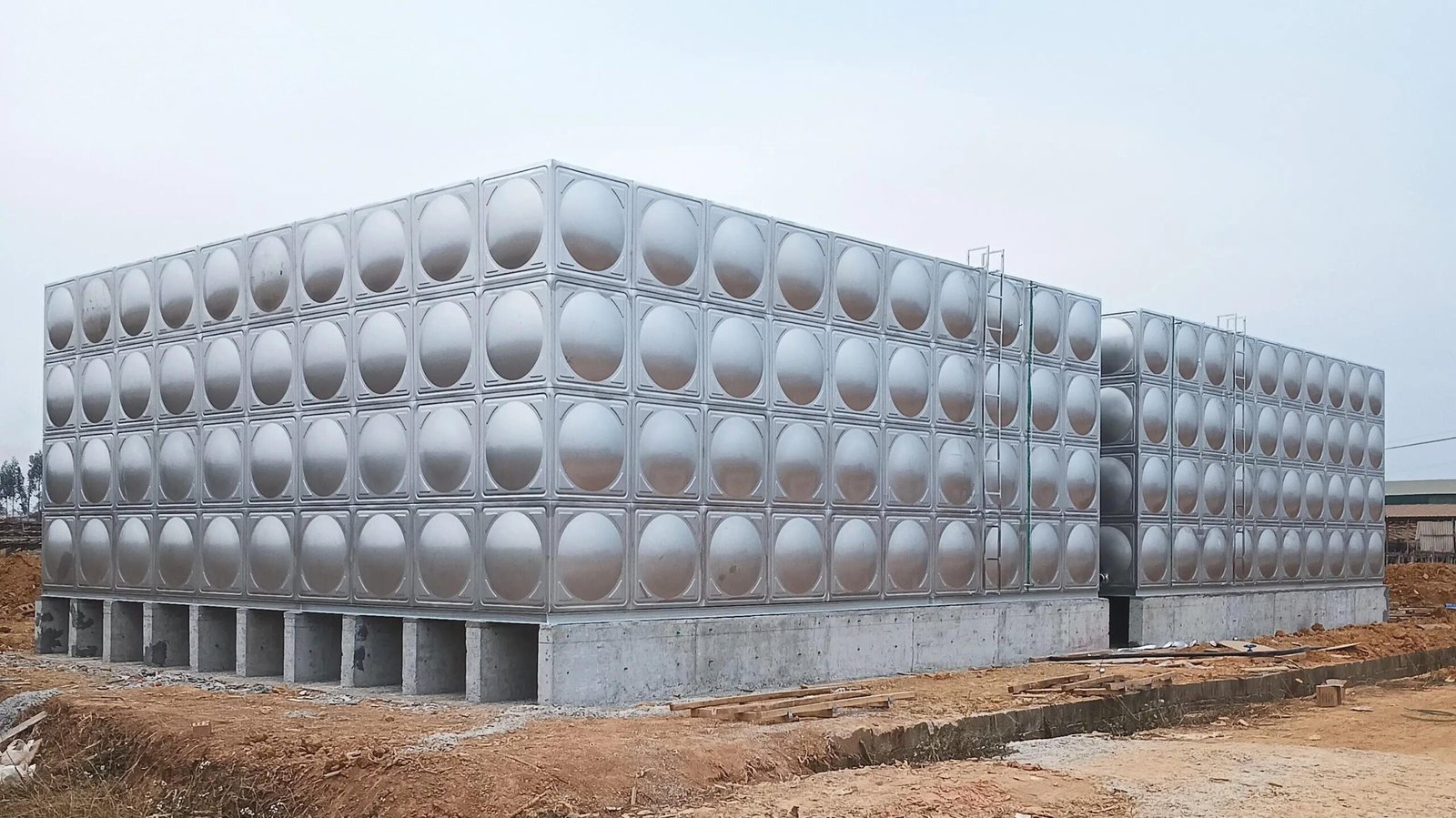
2. Key Takeaways
Stainless steel tank pricing is an engineering bill of materials, not a per-litre commodity number.
Source: cost factors below are RFQ-stage ZENTVO pricing drivers; final prices require approved drawings and current ASTM A240 stainless plate market costs.
- 304 / 304L is the baseline for normal indoor potable-water tanks; 316 / 316L costs more because molybdenum improves chloride resistance.
- Usable volume costs more than nominal volume because freeboard, outlet height and dead storage add physical tank size.
- Panel thickness increases at lower courses because water pressure rises about 9.81 kPa per metre of depth.
- Nozzle quantity and size change cost when DN80–DN300 connections need reinforcement, flanges and pipe supports.
- Freight cost depends on packed volume, not only tank volume; modular panels reduce shipping space compared with one-piece vessels.
- Installation cost rises when the tank must pass through 800–1,200 mm doors, rooftop hatches, stair turns or restricted plant rooms.
- Stainless raw material (304 plate) typically tracks at USD 2.5–4 / kg and 316 at USD 4–6 / kg at current mill prices — fluctuations directly affect tank cost.
3. Price Driver Matrix
The biggest stainless tank price differences come from specification choices made before production.
Source: this matrix is a procurement screening framework; it does not replace a supplier quotation.
| Cost driver | 💰 Lower-cost route | 💸 Higher-cost route | Price impact | Why it changes price |
|---|---|---|---|---|
| Stainless grade | 304 / 304L | 316 / 316L | +17–30 % | 316 includes molybdenum for higher chloride resistance |
| Capacity | 10–50 m³ | 200–500 m³ | Non-linear (economies of scale) | Larger volume increases panels, bracing, packing and foundation load |
| Height | 1–3 m | 4–5 m | +5–15 % | Higher water depth increases bottom pressure and panel thickness |
| Shape | Simple rectangle | Irregular / partitions | +10–25 % | More panels, corners, bracing and drawing time |
| Nozzles | DN50–DN80 standard | DN150–DN300 reinforced | +3–12 % | Larger pipe openings need reinforcement and flange work |
| Accessories | Manhole + drain only | Ladder, platform, instruments, insulation | +8–25 % | Each item adds material, labour and packing |
| Site access | Open floor / crane | Basement, roof, narrow door | +5–20 % | More handling time and split-panel planning |
| Documentation | Basic commercial file | Potable + consultant + municipal | +2–8 % | Certificates, drawings and review cycles add engineering time |
| Incoterm | EXW | DAP / DDP | +10–30 % | Freight, insurance, customs clearance built into price |
4. Grade: 304 vs 316 Price Impact
The stainless grade is the most visible price difference, but also one of the easiest to justify technically.
Source: grade-selection thresholds summarize ZENTVO’s stainless selection guidance, Nickel Institute and World Stainless reference data; should be confirmed against the water analysis.
Use 304 / 304L for normal indoor potable water when chloride is below about 200 mg/L, temperature is ambient and inspection access is good. Use 316 / 316L for coastal sites, higher chloride, critical public water or harder cleaning chemistry. The 304 vs 316 Stainless Steel Water Tanks guide explains this choice in detail.
| Condition | 304 route | 316 route | Recommendation |
|---|---|---|---|
| Indoor commercial potable water | ✅ Baseline price | Optional upgrade | 304 — savings justified |
| Coastal rooftop installation | ⚠️ Higher risk | ✅ Preferred | 316 — upgrade worth the cost |
| Chloride below 200 mg/L | ✅ Usually acceptable | Conservative but +25 % cost | 304 |
| Chloride above 200 mg/L | ❌ Not the default | ✅ Primary stainless option | 316 |
| Hospital or municipal potable reserve | Check risk consequence | ✅ Often justified | 316 — lifecycle insurance |
| Fire reserve (long stagnation) | Check cleaning plan | ✅ Preferred | 316 when inspection interval is long |
| Industrial utility water | Water analysis dependent | Water analysis dependent | Test first, decide second |
The price mistake: buying 304 for a 316 environment or buying 316 when 304 would be sufficient. Both errors waste money — just in different directions.
5. Worked Example: 316 Upgrade on a 100 m³ Tank
A useful budget estimate calculates the price drivers separately, then compares options on the same scope.
Source: the index below is an illustrative cost model anchored to 2026 indicative mill prices; not a ZENTVO quotation.
Project assumption: A 100 m³ indoor potable-water tank with 8 nozzles, ladder, level indicator, packing and remote installation guidance.
Indexed calculation: – 304 bolted tank base supply index: 100 – Stainless panel + accessory portion: 70 % of supply scope – 316 material upgrade premium: +25 % on that 70 % portion
316 supply index   = 100 + (100 × 70 % × 25 %) = 117.5
          Accessories + docs = 12 index points (unchanged)

          304 total = 100 + 12   = 112
          316 total = 117.5 + 12 = 129.5

          Net 316 premium = (129.5 − 112) / 112 ≈ 15.6 %
          Or vs base 100  = 29.5 %
| Cost item | 304 (USD indicative) | 316 (USD indicative) |
|---|---|---|
| Base tank supply (panels + structure) | $16,000 – 22,000 | $20,000 – 27,500 |
| Accessories + documents | $2,000 – 6,000 | $2,000 – 7,500 |
| Estimated ex-works total | $18,000 – 28,000 | $22,000 – 35,000 |
| Net premium | Baseline | +25 % typical, up to +30 % |
Recommendation: Request both 304 and 316 quotes only when chloride, coastal exposure or project consequence makes the comparison meaningful. Otherwise, lock the grade in the specification and avoid burning supplier time.
6. Capacity and Usable Volume — Why Tank Price ≠ Water Price
Tank price follows physical tank size, not the water volume a buyer writes in the first email.
Source: sizing numbers use standard rectangular volume calculation and water density assumptions for RFQ planning.
A buyer who asks for 100 m³ storage may need 110–115 m³ nominal tank volume after freeboard, outlet height and level-control allowance. A nominal 100 m³ tank with 0.35 m non-usable depth over a 5 m × 5 m footprint loses 8.75 m³ of usable storage.
The Stainless Steel Bolted Tanks Sizing Guide gives the full sizing method. In pricing terms, the difference matters because a 115 m³ tank needs more panels, more bolts, more gaskets and a heavier packing list than a 100 m³ nominal tank — typically +8–15 % cost.
Volume economy of scale:
| Capacity | Approx USD / m³ (304) | Why per-m³ drops |
|---|---|---|
| 10 m³ | $350 – 550 | Fixed engineering + minimum panel batch |
| 50 m³ | $220 – 340 | Better panel/freight density |
| 100 m³ | $180 – 280 | Optimum size for modular building tanks |
| 200 m³ | $160 – 250 | Larger panel batches, lower per-m³ engineering |
| 500 m³ | $140 – 230 | Industrial scale economies |
7. Nozzles, Accessories and Documentation — The Hidden 10–25 %
Nozzles and accessories are small in photos but large in procurement detail.
Source: nozzle ranges are ZENTVO RFQ planning ranges; final DN size and reinforcement follow the approved nozzle schedule.
| Item | Typical range | Indicative cost add | Price effect |
|---|---|---|---|
| Inlet / outlet | DN50–DN300 | $80–600 / nozzle | Larger DN needs flange, reinforcement, pipe support |
| Overflow | DN50–DN300 | $80–500 / nozzle | Should match or exceed inlet flow path |
| Drain | DN50–DN150 | $60–250 / nozzle | Adds valve, floor drain planning, cleaning value |
| Manhole | 600 mm clear access | $250–600 | Required for inspection and cleaning |
| Ladder / platform | Project-specific | $400–2,500 | Adds stainless material and safety detailing |
| Insulation | 50–100 mm | $40–80 / m² shell | Adds panels, cladding and packing volume |
| Level instruments | Float / gauge / 4–20 mA | $150–1,500 each | Adds fittings and electrical coordination |
| Anti-vortex plate | Per pump suction | $200–500 | Critical for fire reserve |
| NSF 61 / WRAS certification doc | Per project | $300–1,500 | Certifies wetted parts including gaskets |
Use the Water Tank Nozzle Schedule Guide before comparing supplier quotes. A quote with 6 nozzles is not equal to a quote with 2 nozzles — yet this is the most common apples-to-oranges trap in tank procurement.
8. Freight and Installation Access
Freight and installation cost depend on packed volume, access route and site labour.
Source: logistics values are practical procurement planning ranges for export and building-services projects.
Bolted stainless tanks travel as panels, bolts, gaskets and accessories, so packing is compact. That is why the bolted format is common for overseas EPC and restricted-access projects. A welded tank may work better for a small open-site vessel, but a one-piece vessel above 10–20 m³ becomes difficult to move through buildings.
Indicative freight ranges (ex-works to destination port):
| Destination region | 100 m³ bolted tank (20 ft container) | 100 m³ welded tank (specialized transport) |
|---|---|---|
| Southeast Asia | $1,500 – 3,000 | $3,500 – 7,000 |
| Middle East / Africa | $2,500 – 5,000 | $5,500 – 12,000 |
| Europe | $3,000 – 6,000 | $7,000 – 14,000 |
| Americas | $4,500 – 8,500 | $10,000 – 20,000 |
For an existing hotel or hospital, access route cost can exceed material differences. Measure before sending RFQ:
- Door clear opening in mm
- Lift car length, width, height and load limit
- Stair turn width and landing depth
- Rooftop hatch size
- Crane reach and lifting time
- Plant-room working clearance around the tank
If any route is below 1,000 mm, ask whether half panels or smaller modules are required (panels can usually be made in 500 × 1,000 mm for tight access — small unit-cost penalty, large logistics saving).
9. Hidden-Cost Checklist — 11 Items That Move Quotes by 10–30 %
When comparing two stainless tank quotes, the gap is usually not in the panels — it’s in what’s missing. Check that both quotes include:
| # | Item to check | Common gap | Cost impact |
|---|---|---|---|
| 1 | Mill test certificate (ASTM A240) | Sometimes excluded | $200–800 |
| 2 | NSF/ANSI 61 or WRAS BS 6920 for gaskets | Often missing | $300–1,500 |
| 3 | Reinforcement plates at DN100+ nozzles | Quietly omitted | $150–600 / nozzle |
| 4 | Tie rods / external bracing for >4 m height | Engineering shortcut | $500–3,000 |
| 5 | Floor panel thickness (≥ 3 mm) | Reduced to 2 mm | $400–1,500 |
| 6 | Bolt grade match (A2-70 vs A4-70) | Mixed-grade fasteners | Long-term corrosion risk |
| 7 | Hydrostatic test before shipment | Not always included | $200–800 |
| 8 | Passivation per ASTM A380 (welded only) | Skipped | $400–2,000 |
| 9 | Export-grade packing | “Standard” vs sea-worthy | $300–1,200 |
| 10 | Installation manual + drawing in buyer’s language | English-only | $100–400 |
| 11 | After-sales warranty period | 12 vs 24 vs 36 months | Lifecycle risk |
Rule of thumb: if a competitor’s quote is >20 % lower than ZENTVO’s on equivalent capacity, items 1–11 are usually the explanation.
10. Lifecycle Cost Matrix
The cheapest stainless steel water tank is the one that meets the service condition without avoidable maintenance.
Source: lifecycle ranges are planning values for procurement comparison and must be refined with project water chemistry and inspection policy.
| Scenario | Better specification | Inspection interval | 20-year cost risk |
|---|---|---|---|
| Indoor low-chloride potable water | 304 bolted tank | 12 months | Low if turnover is good |
| Coastal rooftop tank | 316 bolted tank | 6–12 months | Medium if accessories are mixed-grade |
| Hospital potable storage | 316 or documented 304 route | 6 months | Medium — downtime consequence high |
| Industrial utility water | Grade per water analysis | 3–12 months | High if chemistry changes after purchase |
| Restricted basement replacement | Bolted panels | 12 months | Low — vs welded removal cost |
| Fire reserve (long stagnation) | 316 bolted | 6 months visual + annual functional | Medium — stagnation + chloride risk |
Do not compare price without the inspection interval. A tank that saves 10 % at purchase but needs one avoidable repair event during the first 5 years is not cheaper.
11. Standards and Price Evidence
Standards affect price when they change material evidence, inspection requirements or document packages.
| Reference | Price relevance |
|---|---|
| NSF/ANSI/CAN 61 | Drinking-water-contact evidence for products and components.1 |
| WRAS BS 6920 | UK testing route for non-metallic materials in contact with wholesome water.2 |
| ASTM A240 | Stainless steel plate specification — mill test reports come from here.3 |
| ASTM A380 | Cleaning, descaling and passivation — adds to welded tank cost.4 |
| ISO 9001 | Manufacturing quality-management documentation.5 |
| ISO 14001 | Environmental management — increasingly required in public tenders.6 |
| AWWA D103 | Bolted steel water storage reference for projects that specify AWWA.7 |
| EN 10088 | Stainless grade designation reference for 304/316 family materials. |
When a supplier price is much lower, check whether certificates, drawings, gaskets, nozzles, packing and installation documents are included.
12. RFQ Checklist for Accurate Pricing
Send a complete RFQ so suppliers price the same tank. ZENTVO typically returns a quotation within 24 hours:
Capacity & geometry – Required usable capacity and preferred nominal capacity (m³ or litres). – Tank shape and maximum available space (L × W × H). – Installation access route: door, lift, hatch and crane dimensions.
Service conditions – Indoor, outdoor, coastal, rooftop or basement location. – Water analysis: chloride in mg/L, pH, temperature, disinfectant. – Stainless grade: 304, 316 or supplier recommendation.
Mechanical scope – Nozzle schedule with DN sizes and flange standard (ANSI / EN / JIS / GB). – Accessories: ladder, manhole, level indicator, insulation, platform, instruments. – Potable approval requirements (NSF 61 / WRAS / local).
Project & logistics – Destination port, delivery deadline and site installation scope. – Preferred Incoterm: EXW / FOB / CIF / DAP / DDP. – Document package (consultant submittal, mill cert, weld procedure, etc.).
👉 Request a Technical Proposal — typical engineering reply within 24 hours.
13. FAQ — Stainless Steel Water Tank Pricing
Source: FAQ figures summarize the pricing calculation and selection thresholds described above. Real prices vary by project.
How much does a 100 m³ stainless steel water tank cost?
A 100 m³ 304 stainless steel bolted tank typically costs USD 18,000–28,000 ex-works in 2026, with USD/m³ between $180–280. A 316 equivalent runs USD 22,000–35,000 (≈ +25–30 %). Add $1,500–8,500 for freight depending on destination, and 5–25 % for accessories like ladders, insulation or instruments. ZENTVO can return a project-specific number within 24 hours of receiving a complete RFQ.
What is the main factor in stainless steel water tank price?
The main factor is the engineered scope, not just capacity. Stainless grade, usable volume, panel thickness, nozzles, accessories, documentation and access route all change the final price. Roughly: grade + capacity = 70 % of price, accessories + nozzles + freight = 25 %, documentation = 5 %.
Is 316 stainless steel worth the higher price?
316 stainless steel is worth the +25–30 % premium when chloride > 200 mg/L, coastal exposure, hospital duty, municipal service or aggressive cleaning raises corrosion consequence. For normal indoor potable water below ~200 mg/L chloride, 304 often keeps lifecycle cost lower when inspection access and water turnover are good.
Why do stainless steel water tank quotes differ so much?
Quotes differ because suppliers may include different nozzles, panel thickness, gaskets, ladders, packing, certificates, installation guidance and freight assumptions. The gap is rarely in the steel — it’s in what’s missing. Compare the GA drawing, nozzle schedule and document list before comparing the final number. A lower quote missing DN150 reinforcement is not cheaper.
What is the price per m³ of a stainless steel water tank?
Indicative 2026 ex-works ranges: – 10 m³: $350–550 / m³ (304), $450–700 / m³ (316) – 100 m³: $180–280 / m³ (304), $220–350 / m³ (316) – 500 m³: $140–230 / m³ (304), $190–310 / m³ (316)
Per-m³ cost drops with scale because engineering and minimum panel batch are fixed.
Does tank height affect price?
Yes. Tank height affects price because water pressure rises 9.81 kPa per metre of depth. Lower courses need thicker panels (up to 5 mm vs 1.5 mm at the top) or more reinforcement, and the foundation load becomes more concentrated. A taller tank saves floor area under tight footprint conditions, but typically adds 5–15 % when water depth exceeds 4 m.
How can I reduce stainless tank cost without increasing risk?
Safe ways to save 10–20 %: – Right-size usable volume (don’t over-spec) – Avoid unnecessary 316 in low-chloride indoor water – Simplify nozzle locations (cluster on one face) – Confirm access route before production (avoid emergency panel redesign) – Choose EXW or FOB instead of DAP when buyer can manage freight – Bundle multiple tanks in one PO (shared engineering cost)
Unsafe ways that look like savings: – Removing drain access, potable evidence or foundation checks – Reducing floor panel below 3 mm – Skipping mill test certificates
What is the typical lead time after price agreement?
For standard ZENTVO 304/316 configurations: 4–6 weeks from approved drawing to ex-works. Custom geometries, special grades or extended accessory scope: 6–10 weeks. Drawing approval after RFQ submission usually takes 5–7 working days. Freight to most destinations adds 3–6 weeks by sea.
Are there volume discounts for ordering multiple tanks?
Yes. ZENTVO and most reputable suppliers offer 5–15 % discount when 3+ tanks of similar geometry are ordered together — shared engineering, panel-batch efficiency and consolidated freight. Standardizing nozzle schedules and accessories across tanks adds another 3–8 % saving.
How do raw stainless prices affect tank quotes?
Stainless plate (ASTM A240) is the single largest material cost in a tank — typically 40–55 % of ex-works price. In the budget model reviewed on 2026-06-25, plate inputs of ~USD 2.5–4 / kg for 304 and ~USD 4–6 / kg for 316 mean a ±10 % plate-price swing can move tank cost by roughly ±4–6 %. Treat these as dated planning inputs and obtain a current quotation before procurement.
Review Record
This article was reviewed by the ZENTVO water storage engineering team on 2026-06-25 for pricing logic, cost-factor coverage, calculation clarity, indicative range reasonableness, standards references and RFQ completeness. Content reflects ZENTVO’s standard engineering workflow for stainless steel water tank projects delivered across 60+ countries under ISO 9001 & 14001 certified systems.
About the author — The ZENTVO Engineering Team is a multi-disciplinary group covering mechanical design, materials engineering, fabrication QC and project delivery for modular stainless steel, galvanized, GRP/FRP and fire reserve tank systems. Reviews follow ZENTVO’s engineering-led workflow with 24-hour technical response, CAD/GA drawing packages and submittal support before fabrication begins.
Sources
-
NSF, “NSF/ANSI/CAN 61: Drinking Water System Components – Health Effects,” https://www.nsf.org/newsroom_pdf/NSF-ANSI_61_watemarked.pdf ↩
-
WRAS Approvals, “BS 6920 testing requirements,” https://www.wrasapprovals.co.uk/downloads/public_area/documents/213_ver4_pub.pdf ↩
-
ASTM International, “ASTM A240/A240M – Standard Specification for Chromium and Chromium-Nickel Stainless Steel Plate, Sheet, and Strip,” https://store.astm.org/a0240_a0240m-26.html ↩
-
ASTM International, “ASTM A380/A380M – Standard Practice for Cleaning, Descaling and Passivation of Stainless Steel Parts, Equipment and Systems,” https://store.astm.org/a0380_a0380m-25.html ↩
-
ISO, “ISO 9001 Quality management systems,” https://www.iso.org/iso-9001-quality-management.html ↩
-
ISO, “ISO 14001 Environmental management systems,” https://www.iso.org/iso-14001-environmental-management.html ↩
-
American Water Works Association, steel water storage standards and manuals, https://www.awwa.org/ ↩
Need a Tank Proposal?
Send capacity, water chemistry, site conditions and required standards. ZENTVO engineers can review the application and return a practical tank recommendation.
Send Requirements