
By the ZENTVO Engineering Team — a water storage engineering group designing modular stainless steel, galvanized, GRP/FRP and fire reserve tank systems for international building-services, municipal and industrial projects in 60+ countries, with ISO 9001 & 14001 certified systems and a 24-hour engineering response workflow.
TL;DR — Bolted vs Welded Stainless Steel Tank in 6 Lines
- Bolted wins when access is restricted: panels fit through standard 800–1,200 mm doors and lifts; installation takes 3–7 days.
- Welded wins when the project needs the smoothest internal surface, fewer gasketed joints and frequent CIP/wash-down.
- 20-year lifecycle cost for a 100 m³ potable tank is often nearly identical (both ~150 indexed) — the real decision is access, not price.
- 304 / 304L works below ~200 mg/L chloride; switch to 316 / 316L for coastal, hospital or higher-chloride duty — applies to both formats.
- Foundation flatness ±5 mm matters for bolted; weld passivation per ASTM A380 matters for welded.
- For most building, rooftop and EPC export projects → bolted. For food, beverage, process water → welded.
1. The 60-Second Decision
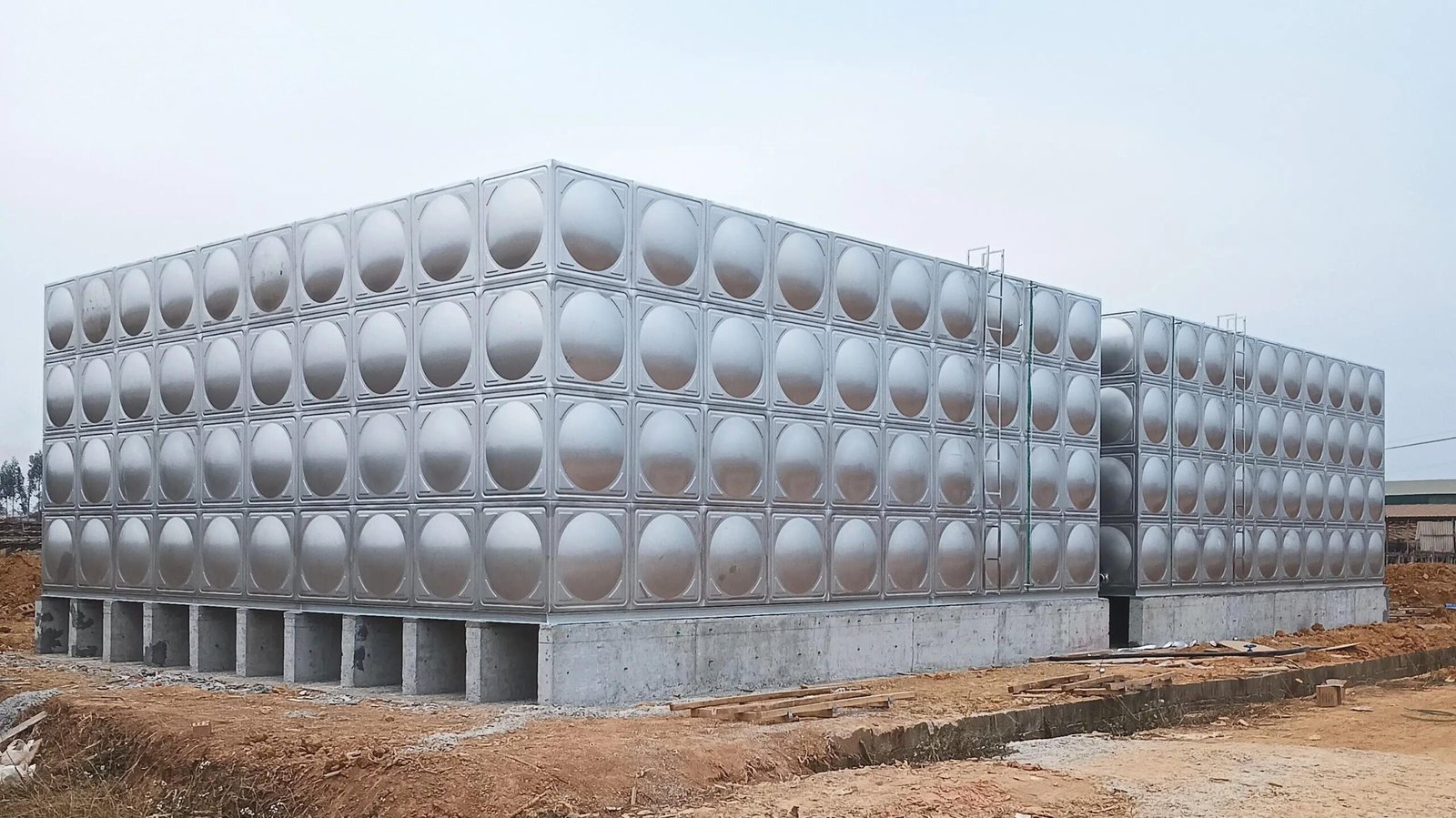
Choose a bolted stainless steel tank when the project needs modular delivery, restricted-site installation, faster replacement or easier export packing. Choose a welded stainless steel tank when the project needs the smoothest internal surface, a compact factory-built vessel, fewer gasketed joints or a high-hygiene process design. The material grade, water chemistry and site access matter more than the label “bolted” or “welded.”
Scope of this comparison: stainless-only decisions such as passivation, gasketed joints, cleanability and 304/316 grade consistency. The broader bolted vs welded steel tank guide covers carbon-steel and coated systems; this article does not repeat that material comparison.
For most building potable-water, rooftop, basement and overseas EPC projects, bolted stainless steel tanks are easier to move through doors, lifts and tight plant rooms. For open-site food, beverage or process-water projects where the tank is delivered or welded in position, welded stainless steel reduces gasket maintenance.
If you are comparing both formats, request a quote with capacity, room dimensions, water analysis and nozzle schedule so ZENTVO prices both layouts on the same basis.
2. Decision Tree — Pick Your Format in 4 Questions
Q1: Can a fully-assembled tank physically reach the install location?
              │
              ├── ❌ No (door <1.2 m, basement, rooftop, lift only)  →  BOLTED
              │
              └── ✅ Yes
                      │
                      Q2: Will the tank be cleaned-in-place daily or store food/beverage?
                      │
                      ├── ✅ Yes (food, pharma, brewery, high-CIP)   →  WELDED
                      │
                      └── ❌ No (potable, fire reserve, utility)
                              │
                              Q3: Is the buyer likely to relocate or expand within 10 yrs?
                              │
                              ├── ✅ Yes  →  BOLTED (panel-replaceable)
                              │
                              └── ❌ No
                                      │
                                      Q4: Is on-site welding & passivation available?
                                      │
                                      ├── ✅ Yes  →  Either — compare cost & lead time
                                      │
                                      └── ❌ No  →  BOLTED (default for safer install)
This decision tree covers ~90 % of building, municipal and EPC projects. The remaining 10 % (large field-erected tanks, pressure vessels, sanitary process tanks) need code-specific review (AWWA D100, ASME BPVC, 3-A SSI, etc.).
3. Key Takeaways
A bolted tank is mainly an installation and logistics decision. A welded tank is mainly a hygiene and joint-count decision.
Source: chloride and service-life figures in this section are screening values from ZENTVO’s stainless tank selection guidance and Nickel Institute reference data; they must be checked against the project water analysis.
- Bolted stainless steel tanks fit restricted access, export projects and modular replacement because panels are carried into the site.
- Welded stainless steel tanks suit open access, high-hygiene internal surfaces and compact factory-built vessels.
- 304 stainless steel is normally used for clean indoor potable water below about 200 mg/L chloride; 316 stainless steel is preferred for coastal or higher-chloride service.
- Bolted joints need gasket selection, torque control and foundation flatness (±3 mm over 3 m, ±5 mm overall).
- Welded seams need weld quality, passivation per ASTM A380, and heat-affected-zone inspection.
- A fair comparison must include 20-year inspection cost, not only first purchase price.
4. Quick Comparison Table
Source: this comparison is a ZENTVO engineering selection matrix for RFQ-stage screening; final choice must follow the approved drawing and project specification.
| Decision point | 🔩 Bolted SS Tank | 🔥 Welded SS Tank |
|---|---|---|
| Site access | ✅ Panels fit restricted doors and lifts | ❌ Needs full tank delivery or site welding access |
| Typical modular panel | 1,000 × 1,000 mm or 1,220 × 1,220 mm | Not panel-based |
| Internal surface | Gasketed joints visible in some designs | ✅ Smooth welded shell when finished correctly |
| Leakage risk mode | Joint and gasket compression | Weld defect or heat-affected-zone |
| Installation time (100 m³) | 3–7 days | 7–15 days (site-welded) |
| Maintenance focus | Gaskets, bolt torque, foundation movement | Weld seam inspection, passivation, surface cleaning |
| Best capacity range | 5 – 1,000 m³ modular | 1 – 200 m³ factory; larger site-welded |
| Re-location possible | ✅ Disassemble + new gaskets | ❌ Usually not practical |
| Future expansion | ✅ Add panels | ❌ Requires re-welding |
| Lead time (ZENTVO) | 4–6 weeks standard | 6–10 weeks |
| Drinking-water certification | NSF/ANSI 61, WRAS BS 6920 | NSF/ANSI 61 |
| Best fit | Potable, fire reserve, municipal buffer, export, basement/rooftop | Food, beverage, process water, high-hygiene rooms |
The broader Bolted vs Welded Steel Water Tanks article covers carbon steel and galvanized options. This page focuses only on stainless steel.
5. When Bolted Stainless Steel Wins
Bolted stainless steel wins when the project value comes from access, assembly and replacement flexibility.
Source: the numeric examples in this section are practical installation planning ranges from ZENTVO modular tank projects delivered in 60+ countries.
Use bolted construction when:
- ✅ The tank must enter through an 800–1,200 mm door, stair or goods lift.
- ✅ The installation is in a basement, rooftop plant room or existing building.
- ✅ The buyer needs export packing in containers instead of moving a large vessel.
- ✅ The tank volume is 10–1,000 m³ and a rectangular modular shape fits the room.
- ✅ The site wants future dismantling, expansion or panel replacement.
- ✅ The project needs several tanks with shared panels, gaskets and accessories (cost-down through standardization).
Bolted tanks fail when: – ❌ The foundation is uneven (>±5 mm overall) — small leaks that look like material failure but are actually installation failure. – ❌ The gasket is not matched to the water (e.g. wrong elastomer for hot or chlorinated water). – ❌ The bolt sequence is rushed and compression is uneven.
Engineering note: A bolted tank seals through repeated contact pressure along every panel joint — not through a fused metal seam. That is why gasket selection, bolt torque control and foundation flatness are non-negotiable for ZENTVO bolted projects.
For product details, see the ZENTVO Stainless Steel Bolted Water Tank page, or the companion Stainless Steel Bolted Tanks Sizing Guide for capacity and panel-thickness planning.
6. When Welded Stainless Steel Wins
Welded stainless steel wins when the internal surface and joint count are more important than modular access.
Source: welded tank selection below is a procurement-stage comparison for water and light-process storage; pressure vessels and food-grade process tanks need their own code review (ASME BPVC, 3-A SSI, EHEDG).
Use welded construction when:
- ✅ A complete vessel can be delivered through the site access route.
- ✅ The tank is small enough for factory fabrication, commonly 1–50 m³.
- ✅ The owner wants fewer gasketed joints for hygiene or audit reasons.
- ✅ The internal surface must be smooth (Ra ≤ 0.8 µm) for cleaning or pharma.
- ✅ The process has frequent clean-in-place or wash-down cycles.
- ✅ Site welding, passivation and inspection are available if the vessel is not factory-built.
Welded tanks fail when: – ❌ Heat tint, poor passivation, pinholes or distorted nozzles are not inspected. – ❌ Carbon-steel tools or grinding wheels contaminate the stainless surface (per Nickel Institute guidance). – ❌ Welded near coastal salt air without proper passivation — molybdenum in 316 helps, but does not correct poor welding practice.
Engineering note: Welding changes the stainless surface near the seam; that heat-affected zone (HAZ) needs cleaning and passivation per ASTM A380 so the chromium-rich passive film reforms. This matters even for 316 stainless.
For a product alternative, review the ZENTVO Stainless Steel Welded Water Tank page.
7. Leakage and Corrosion Risk Comparison
Bolted and welded stainless tanks have different failure modes, not a simple “better or worse” ranking.
Source: this risk matrix uses ZENTVO field-inspection categories and should be paired with the project water analysis.
| Risk | 🔩 Bolted SS Tank | 🔥 Welded SS Tank | Prevention Rule |
|---|---|---|---|
| Gasket leakage | ⚠️ Higher at panel joints | ✅ None at shell joints | Foundation flatness ±5 mm + correct bolt sequence |
| Weld pinhole | ✅ None in panel joints | ⚠️ Possible at seams | DPI or visual weld inspection where specified |
| Crevice corrosion | ⚠️ Possible at gaskets and bolts | ⚠️ Possible at lap welds and deposits | Keep surfaces drainable and cleanable |
| Chloride pitting | Grade-dependent | Grade-dependent | Use 316 above ~200 mg/L chloride or coastal exposure |
| Heat tint corrosion | ✅ Not from panel joints | ⚠️ Possible after welding | Remove heat tint and passivate per ASTM A380 |
| Nozzle stress | Reinforcement plate needed | Reinforcement plate needed | Support external pipe within 1 m of tank wall |
| Iron contamination | ⚠️ During panel forming | ⚠️ During welding | Use stainless-dedicated tools per Nickel Institute guidance |
When chloride, residual disinfectant or coastal salt air is the main concern, the 304 vs 316 decision matters more than the construction format. Use the 304 vs 316 Stainless Steel Water Tanks guide before approving the material.
8. 20-Year Lifecycle Cost — Worked Example (100 m³ Hotel Plant Room)
A lifecycle comparison should include inspection and repair probability, not only first price.
Source: this is an indexed cost model for comparison only; it is not a ZENTVO quotation. Real prices depend on grade, accessories, freight, Incoterm and project location. For a real number, contact ZENTVO with the RFQ checklist below.
Project assumption: A 100 m³ potable-water tank in an existing hotel plant room. Access is via a goods lift (panels fit; complete vessel does not).
Inputs: – Bolted tank first-cost index: 100 – Welded tank first-cost index: 125 (includes temporary wall opening + site welding) – Bolted inspection: 2 index points / year × 20 years = 40 – Welded inspection: 1 index point / year × 20 years = 20 – Bolted expected repair allowance: 10 (gasket replacement once) – Welded expected repair allowance: 5 (one weld touch-up + passivation)
Calculation:
20-year cost = first cost + (annual inspection × 20) + repair allowance

          Bolted   = 100 + (2 × 20) + 10  = 150
          Welded   = 125 + (1 × 20) + 5   = 150
Result: Both options end at the same 20-year indexed cost.
| Cost item | 🔩 Bolted SS | 🔥 Welded SS |
|---|---|---|
| First-cost index | 100 | 125 |
| Inspection over 20 years | 40 | 20 |
| Expected repair allowance | 10 | 5 |
| 20-year total index | 150 | 150 |
| Indicative USD range (100 m³)* | $18,000 – $28,000 first cost | $22,000 – $35,000 first cost |
| Better value when | Access is restricted | Hygiene & smooth surface dominate |
* Indicative ranges only — vary by grade (304 vs 316), accessories, freight, Incoterm and destination country. Request a ZENTVO quotation for project-specific pricing.
The real takeaway: If both columns end at the same 20-year cost, the decision shifts to non-financial factors — access, downtime tolerance, future expansion, and hygiene class.
9. Standards and References
Stainless tank specifications should name standards by function, not as a decorative list.
| Reference | Use in the decision |
|---|---|
| NSF/ANSI/CAN 61 | Health-effects evaluation for drinking-water-contact products and materials.1 |
| WRAS BS 6920 | UK testing route for non-metallic water-contact materials such as gaskets and sealants.2 |
| AWWA D103 | Bolted steel tank reference when the consultant specifies an AWWA bolted system.3 |
| AWWA D100 | Welded carbon steel tank reference for large field-welded water storage comparisons.3 |
| ASTM A380 | Cleaning, descaling and passivation of stainless steel — critical for welded tanks.4 |
| ASTM A240 | Standard specification for stainless steel plate, sheet and strip used in tank panels.5 |
| EN 10088 | European stainless steel grade designation reference for 304/316 family materials.6 |
| ISO 9001 | Quality management system reference for manufacturing and document control.7 |
| ISO 14001 | Environmental management — increasingly required in public tenders.8 |
For potable stainless tanks, standards approval must cover the wetted system: panels, nozzles, gaskets, sealants, internal accessories and cleaning method.
10. RFQ Checklist
Send the same data for bolted and welded options so the comparison is fair. ZENTVO typically returns both layouts within 24 hours.
Capacity & geometry – Required usable volume in m³ or litres. – Maximum installation room length, width and height. – Access route dimensions: door, lift, stair, crane and roof opening.
Service conditions – Water type, chloride in mg/L, pH, temperature and disinfectant. – Stainless grade requested: 304, 316 or recommendation needed. – Required hygiene class (potable / fire reserve / food / process).
Mechanical scope – Nozzle schedule with DN size and pipe material. – Flange standard: ANSI / EN / JIS / GB. – Potable approval requirements: NSF/ANSI 61 or WRAS BS 6920. – Foundation type, floor load limit and drainage route. – Cleaning frequency and inspection access requirement.
Project & logistics – Destination country, schedule and document package. – Preferred Incoterm: EXW / FOB / CIF / DAP.
👉 Request a Technical Proposal — typical engineering reply within 24 hours.
11. FAQ — Bolted vs Welded Stainless Steel Tanks
Source: FAQ thresholds and lifecycle figures summarize the selection rules and indexed calculation in the article above.
Are bolted stainless steel tanks reliable?
Bolted stainless steel tanks are reliable when the foundation is flat (±5 mm overall), the gasket material fits the stored water, and the bolt sequence is controlled during assembly. Most preventable leakage problems come from uneven base support, wrong gasket compression or pipe stress at nozzles — not from the stainless panels themselves. ZENTVO bolted tanks have a typical service life of 20–35 years depending on grade and water chemistry.
Are welded stainless steel tanks more hygienic?
Welded stainless steel tanks are more hygienic when the welds are smooth, cleaned and passivated correctly per ASTM A380. The advantage is fewer gasketed joints inside the tank. The risk is that poor weld finishing or heat tint creates corrosion-prone areas, so weld inspection and passivation records matter. For potable water and fire reserve, a properly-fabricated bolted tank meets the same drinking-water standards (NSF/ANSI 61, WRAS BS 6920).
Which is cheaper, bolted or welded stainless steel?
For a 100 m³ restricted-access building tank, the 20-year lifecycle cost is nearly identical (~150 indexed). Bolted is cheaper on first cost when panels can be carried in without demolition. Welded is cheaper on inspection cost because there are fewer gasketed joints to maintain. The decision usually comes down to access, downtime and expansion, not absolute price.
How long does it take to install each format?
A 100 m³ ZENTVO bolted tank typically takes 3–7 days for on-site assembly with a 2–3 person crew, plus 1–2 days for hydrostatic testing and commissioning. A welded tank of the same size typically takes 7–15 days of site welding plus inspection and passivation, or arrives factory-built (1-day install) if access permits.
Should I choose 304 or 316 for bolted and welded tanks?
Choose 304 for normal indoor potable water with chloride below about 200 mg/L and stable disinfection. Choose 316 for coastal, high-chloride, critical municipal, hospital or harder cleaning conditions. The grade decision applies to both bolted and welded tanks, including nozzles, bolts and accessories. Mixed-grade fasteners or ladders are a common cause of early corrosion.
Is a bolted tank easier to replace?
Yes. A bolted stainless tank is dismantled and removed through the same access route used for installation. That matters in basements, rooftops and plant rooms where a welded tank would need cutting or wall opening. Always replace gaskets during reassembly — never reuse compressed old seals.
Can a welded stainless tank be repaired on site?
Yes, but it requires certified welders, stainless-dedicated tools, passivation chemicals and inspection capability. Most public-water utilities prefer to drain and re-weld during a planned shutdown rather than emergency repair. Bolted tanks are usually faster to repair (replace one panel + gaskets) but require panel inventory and gasket compatibility.
Which format is better for fire reserve water?
For fire reserve duty, bolted stainless tanks are usually preferred because: (1) tanks are often installed in plant rooms with restricted access, (2) the long stagnation period favors a tank that can be dismantled for inspection, and (3) lifecycle cost is competitive. Welded fire tanks are common only when factory delivery is straightforward.
How does ZENTVO support both formats?
ZENTVO offers both bolted and welded stainless steel water tanks under one engineering workflow: requirement review → grade selection → CAD/GA drawings → fabrication → inspection (per ASTM A380) → export packing → installation guidance. The same 24-hour engineering response covers both formats, so buyers can request side-by-side quotations for the same project.
What documents should come with a stainless steel tank, bolted or welded?
Request: GA drawing, panel/shell layout, nozzle schedule, foundation load data, material certificates (mill test reports for ASTM A240 plate), gasket and accessory specifications (NSF 61 / WRAS), weld procedure and passivation records (welded only), packing list, installation manual and inspection checklist.
Review Record
This article was reviewed by the ZENTVO water storage engineering team on 2026-06-25 for stainless tank selection logic, lifecycle comparison, failure-mode coverage, standards fit and RFQ completeness. Content reflects ZENTVO’s standard engineering workflow for both bolted and welded stainless steel water tank projects delivered across 60+ countries under ISO 9001 & 14001 certified systems.
About the author — The ZENTVO Engineering Team is a multi-disciplinary group covering mechanical design, materials engineering, fabrication QC and project delivery for modular stainless steel, galvanized, GRP/FRP and fire reserve tank systems. Reviews follow ZENTVO’s engineering-led workflow with 24-hour technical response, CAD/GA drawing packages and submittal support before fabrication begins.
Sources
-
NSF, “NSF/ANSI/CAN 61: Drinking Water System Components – Health Effects,” https://www.nsf.org/newsroom_pdf/NSF-ANSI_61_watemarked.pdf ↩
-
WRAS Approvals, “BS 6920 testing requirements,” https://www.wrasapprovals.co.uk/downloads/public_area/documents/213_ver4_pub.pdf ↩
-
American Water Works Association, steel water storage tank standards and manuals, https://www.awwa.org/ ↩↩
-
ASTM International, “ASTM A380/A380M – Standard Practice for Cleaning, Descaling and Passivation of Stainless Steel Parts, Equipment and Systems,” https://store.astm.org/a0380_a0380m-25.html ↩
-
ASTM International, “ASTM A240/A240M – Standard Specification for Chromium and Chromium-Nickel Stainless Steel Plate, Sheet, and Strip,” https://store.astm.org/a0240_a0240m-26.html ↩
-
ISO / European Committee for Standardization, “EN 10088 Stainless steels,” https://www.iso.org/standard/72972.html ↩
-
ISO, “ISO 9001 Quality management systems,” https://www.iso.org/iso-9001-quality-management.html ↩
-
ISO, “ISO 14001 Environmental management systems,” https://www.iso.org/iso-14001-environmental-management.html ↩
Need a Tank Proposal?
Send capacity, water chemistry, site conditions and required standards. ZENTVO engineers can review the application and return a practical tank recommendation.
Send Requirements